
MODULE 1 - Climate change and the future of wine: production, geography and impact
MODULE 1
Climate change and the future of wine: production, Geography and impact
Introduction to the module
Structure of the module
Learning Unit 1.1 - Viticulture and territory: from vine to glass
In this section, participants will delve into the fundamentals of wine production, covering the vineyard’s life cycle, key viticulture techniques and the winemaking process. They will learn about how soil, climate, vineyard exposure and location influence the outcome of wine.
Contents:
• Soil structure and composition.
• Climate elements in the viticulture process.
• Exposure and localisation of vineyards.
• The different training systems and their characteristics.
• The annual cycle of the vine.
• The winemaking process
• Wine vessels
• Wine corks
Learning outcomes:
Identify key elements of wine production.
Duration: 3 hours.
Learning Unit 1.2 - Exploring wine geography: a journey through regions
Contents:
Grape varieties, terroir characteristics, key appellations, for major wine regions in:
• Bulgaria, Italy, Spain, Belgium, Luxembourg, Norway
• Rest of Europe: France, Portugal
• Rest of the world: South Africa, California, Australia, Chile
Learning outcomes:
Identify key elements of wine production across major national and international wine-producing regions.
Duration: 5 hours.
Learning Unit 1.3 - The climate shift: how climate change is redrawing wine production and geography.
This learning unit introduces participants to the concept of climate change, its key elements and the complex ways in which it affects the global wine industry. Through a combination of theoretical concepts, practical examples and case studies, learners will gain a comprehensive understanding of how climate change is influencing wine cultivation and production processes, shifting wine-producing regions and reshaping global wine geography and markets.
Contents:
• Key climate factors affecting viticulture: temperature, rainfall and water availability, sunlight and growing season length, extreme weather events, air quality.
• Climate impacts on grape quality and wine characteristics: sugar, acid, and tannin balance; aroma and flavour profiles; climate-driven changes in aromatic compounds and phenolic content, potential for new wine styles.
Learning outcomes:
Recognize key climate factors affecting the sector.
Identify climate impacts on cultivation and quality.
Recognize changes in cultivation areas and markets.
Duration: 2 hours
Learning Unit 1.1 - Viticulture and territory: from vine to glass
1.1.1 Soil in viticulture
Not all soils are suitable for vine cultivation and each vine variety requires soils with specific characteristics. Soil plays a crucial role, acting as a reservoir of water and minerals essential for plant growth. Curiously, vines thrive better in less fertile soils than in rich ones. The same vine can produce grapes with different properties depending on the type of soil in which it is grown. The roots of the vine absorb nutrients from the soil that influence the flavour and quality of the wine. These elements come from the cultivated surface layer and are determined by the geology of the region.
Among the main characteristics of a soil suitable for vines is drainage, which is essential in order to prevent the roots from becoming excessively waterlogged. The presence of mineral salts is also fundamental. Two key aspects are considered when describing a soil: texture and chemical composition.
Texture or grain size or structure refers to the organisation of the various solid particles such as sand, silt and clay. These components have different particle diameters and their functionality on an agronomic level is different. The soil skeleton is composed of the coarsest particles (diameter > 2 mm) and represents the network that is filled in by the fine soil, which constitutes the texture and is the remaining part of the soil composed of smaller particles (diameter < 2 mm). From the point of view of texture, soils can be divided into:
Sand: (0.02 to 2 mm)
Clay, with its finer texture, absorbs water and gradually releases it to the roots, giving compactness and plasticity to the soil, but if it is too abundant, the soil becomes excessively compact and impermeable to water and air, with damage to the roots and to microorganisms useful to the plant;
Silt: (0.002 to 0.02 mm)
The chemical composition of the soil is essential for vine nutrition. Elements such as nitrogen, phosphorous, potassium, calcium and magnesium are essential for plant health and grape metabolism.
Soils ideal for viticulture also contain predominantly limestone, marls, schists and clays.
– Limestone, i.e. calcium carbonate, is a key component found in most soils. It originates from the decomposition of organisms that possess limestone structures such as shells or skeletons. This mineralisation leads to the formation of calcareous sediments that accumulate over large areas of soil.
– Marls are sedimentary rocks that combine a clay component with a carbonate part, usually consisting of calcium carbonate (calcite) or a mixture of calcium carbonate and magnesium (dolomite). Marly sediments are widespread globally, especially in areas that were once marine or lacustrine.
– Shales are medium- to coarse-grained metamorphic rocks that are characterised by their ability to flake easily into thin layers. They are formed by the transformation of clay subjected to high pressures and temperatures, which cause the silica crystals to orient in a specific direction, creating shale planes.
– Clays are very fine sediments composed mainly of clay minerals, i.e. aluminosilicates. Their formation occurs through the leaching of rocks containing these minerals, followed by long transport in lake, marine or lagoon environments during past geological eras.
Soil composition and its effects on wine
Soil Type |
Composition |
Wine Characteristics |
| Limestone-marl | Equal parts of limestone and clay | Deep colors, intense aromas, rich alcohol, low acidity, excellent longevity |
| Limestone-sandstone | Limestone with a fair amount of sand | Balanced alcohol and phenolics, fine aromas, not always suitable for aging |
| Marl-ferruginous | Marl and iron | Produces high-quality wines, also known as “red soils” |
| Clayey soils | High clay content | Intense pigmentation, complex aromas, high alcohol, smoothness, longevity; suitable for red grapes |
| Sandy soils | High sand content | Light structure, good acidity, lower longevity due to leaching of dissolved substances |
Soil vs Terroir
The difference between terrain and terroir in viticulture is fundamental to understanding the complexity of wine production. Although the two terms are sometimes used synonymously, they have distinct and complementary meanings.
The term terrain refers specifically to the physical, chemical and biological characteristics of the soil in which the vines grow. It is a concept closely linked to agricultural science and focuses on technical and measurable aspects.
Terroir is a French term that embraces a much broader and more complex vision that considers viticulture as an art and a science deeply linked to the terroir. Every vineyard is in fact the result of a unique interaction between environment, vine and agricultural practices, influenced by the specific characteristics of the soil, climate and topography, and last but certainly not least, a human factor composed in turn of many variables including the history, culture and traditions of the place. Terroir is therefore not a static and immobile concept, but one that is constantly evolving and in perpetual motion. It is at the heart of quality winemaking, since it defines the identity of wines and their uniqueness.
1.1.2 The vine and the climate
The vine is a particularly weather-sensitive plant. It is vulnerable to both excessive heat during the summer and spring frosts. In addition, it needs good exposure to light and low rainfall. Geographical areas that meet these requirements are in a latitude range of 30° to 50° north and 30° to 40° south. However, there are exceptions due to variable factors that influence wine vintages.
Temperature
The ideal temperatures for vines vary according to the stages of the growing cycle, and are mainly found in the latitudes already mentioned, where from May to August the optimum daytime temperature is between 25 and 28°C. The ideal temperatures for each phase of the vegetative cycle are:
– Sprouting: between 8 and 12°C
– Flowering: between 17 and 22°C
– Until veraison (one of the most important phases in the vine’s vegetative cycle, when the grapes begin the ripening process): between 22 and 25°C
– From veraison to ripening: between 22 and 28°C
– Harvest: between 17 and 23°C
Temperature range and the vine
The role of light in vine cultivation
Moisture in vine cultivation
Rain
The role of soil
Snow
Fog
Dew
Frosts
Winds
Exposure and location of vineyards
The location and exposure of the vineyards are crucial elements in optimising the growing conditions of the vines and guaranteeing the quality of the harvest.
Exposure and location of vineyards
Altitude
– Low altitude: vines grown at low altitude benefit from greater warmth, which favours the production of fuller-bodied, more mature wines.
– High altitude: vines growing at high altitudes are exposed to lower temperatures, which gives the wines more freshness and acidity.
Slope
– Natural drainage: sloping terrain favours water runoff, reducing the risk of water stagnation.
– Better exposure to the sun: slopes allow the sun’s rays to reach the leaves and clusters more easily, promoting optimal growth.
Proximity to water bodies
– Thermal regulation: large bodies of water, such as rivers or lakes, mitigate temperature fluctuations, maintaining a more stable temperature throughout the year.
– Reflection effect: water can reflect sunlight onto vineyards, enhancing photosynthesis and promoting grape development.
1.1.3 Biological cycles of the vine
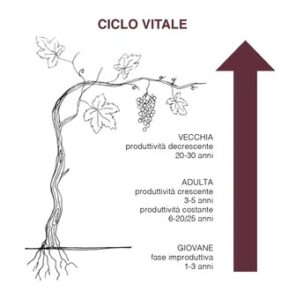
The life cycle comprises moments of vigour, productivity and decline.
There are three phases in the life cycle of a grafted vine:
- Young – from the 1st to the 3rd year of the plant’s life, a phase in which the vine is unproductive.
- Adult – of increasing productivity from year 4 to year 5 and constant from year 6 to year 20-25.
- Old – in this phase, which starts around the age of 30, productivity becomes decreasing.
1. The Weeping
– Period: late winter – early spring (February-March, depending on the climate).
– Description: the vine resumes its biological activity. Drops of nutrient-rich sap (the ‘weeping’) emerge from the pruning cuts.
– Risks: susceptibility to late cold; risk of fungal infections through pruning cuts.
Agricultural activities:
- Completion of winter pruning.
- Preventive treatments to avoid infection (e.g. copper to control fungal pathogens).
2. Sprouting
– Period: March-April.
– Description: buds open and the first shoots begin to develop.
– Risks: late frost that can damage new shoots; attacks by pests such as moths or spider mites.
Agricultural activities:
- Monitoring of temperatures and protection against frost (e.g. frost plugs or frost irrigation).
- Preventive treatments for pests.
- Weed control.
3. Vegetation
– Period: April-June.
– Description: vines rapidly develop new shoots and leaves, increasing leaf area for photosynthesis.
– Risks: occurrence of fungal diseases (e.g. powdery mildew, downy mildew); water shortage in drought areas.
Agricultural activities:
- Fertilisation to support growth.
- Phytosanitary treatments against fungal diseases.
- Canopy management (suckering and clearing) to improve aeration.
4. Flowering
– Period: May-June.
– Description: flowers open and pollination takes place, essential for subsequent fruit set.
– Risks: bad weather (rain, wind or cold) that can compromise pollination; insect attacks.
Agricultural activities:
- Weather monitoring.
- Treatments against harmful insects (e.g. moths).
- Possible irrigation in case of water stress.
5. The Allegation
– Description: the fertilised flowers are transformed into small fruits, giving rise to the bunches.
– Hazards: powdery mildew and downy mildew (two of the main fungal diseases affecting the vine) can affect the bunches; water or nutritional competition.
Agricultural activities:
- Disease and pest control with specific treatments.
- Green pruning (sphemminellatura, a cultivation practice used in viticulture that consists of removing the femminelli, i.e. the side shoots that develop in the axils of the vine leaves, and topping) to optimise the plant’s resources.
6. The Flooding
– Description: the berries begin to change colour (veraison) and accumulate sugar, while acidity decreases.
– Risks: bird attacks, hail, acid rot.
Agricultural activities:
- Application of anti-hail or anti-bird nets.
- Monitoring for rot and specific treatments if necessary.
- Irrigation management to encourage balanced ripening.
7. Ripening
– Description: the berries reach full ripeness with maximum sugar content and optimum aromatic characteristics.
– Risks: bunch rot; attacks by insects such as wasps or vinegar flies.
Agricultural activities:
- Periodic checks to determine the optimal time for harvesting.
- Possible defoliation to improve exposure of the bunches to the sun.
- Harvesting (manual or mechanised).
8. Vegetative Rest
– Description: the vine enters a state of dormancy; the sap withdraws and the leaves fall.
– Risks: extremely cold temperatures can damage wood and roots.
Agricultural activities:
- Dry pruning to shape the vine and encourage future production.
- Basic fertilisation to enrich the soil.
- Possible trunk treatments to protect the plant from pathogens.
1.1.4 The different training systems and their characteristics
Vine training concerns the cultivation and management of rows of vines, including the organisation of the plants and the structures used to support and guide their growth. The different configurations and physical structures adopted, such as trellises, arbours and rows, allow vines to develop in an orderly manner, facilitating agricultural interventions such as pruning, harvesting and disease control. These systems also influence the plants’ exposure to sunlight and ventilation, fundamental factors for grape ripening and the quality of the final product.
A fundamental classification distinguishes between systems without and with trellis. In the first case, we speak of ‘bush’ training, characterised by the independent growth of the vine without supports. In the systems with a stake, a distinction is made between those using live stakes, as in the case of ‘alberate,’ and those with inert stakes, which include all modern forms of training commonly used in contemporary viticulture.
When using inert supports for vine training, two main configurations can be distinguished: those in which the support structure is arranged along the axis of the row and those in which it is placed between the rows. The first case includes espaliers (or counter-espaliers), which are accompanied by various pruning methods. These forms of training, which originated in France and later spread throughout the world, are considered modern systems. In the second case, we find traditional systems such as pergolas, awnings and other configurations that also allow vines to grow radially or transversely to the rows.
The main forms of vine training used are as follows:
1. Sapling
● Characteristics: the vine is kept low and pruned into a bush form. Does not require structural supports.
● Advantages: ideal for hot and windy climates due to low exposure; protects vines from excessive sun.
● Disadvantages: labour-intensive for management and not suitable for humid climates where lack of ventilation can encourage disease.
● Typical areas: Mediterranean, with poor and arid soils.
2. Guyot
● Characteristics: A renewable cane system (part of the vine selected during pruning to ensure continuous production and renewal of the plant’s productive structure), with one or two horizontal canes tied to support wires.
● Advantages: Suitable for a wide range of grape varieties and terrains; facilitates pruning management and yield control.
● Disadvantages: Higher risk of breakage in strong winds.
● Typical regions: France (Burgundy), Italy (Piedmont, Tuscany).
3. Spur-pruned cordon
● Characteristics: A permanent cane (a structural part of the vine that is not removed during annual pruning and serves as a stable base for the plant’s development over the years, also called a “cordon”) is arranged horizontally along the wire; shoots grow vertically from the nodes.
● Advantages: Facilitates mechanical pruning; ensures good exposure to light and air.
● Disadvantages: Rigid system; requires a long training period for the vine.
● Typical regions: Widely used in modern vineyards worldwide.
4. Pergola
● Characteristics: The canes grow on an elevated horizontal structure, forming a canopy.
● Advantages: Protection from excessive sun and rain; allows for mixed cultivation (e.g., vines and vegetables).
● Disadvantages: Complex maintenance; may reduce grape quality in very humid climates.
● Typical regions: Trentino-Alto Adige, Japan.
5. Tendone
● Characteristics: Similar to the pergola system, but the canes grow on a horizontal net supported by poles. Bunches are suspended for easy harvesting and extensive soil shading.
● Advantages: Suitable for high production; provides sun protection.
● Disadvantages: Requires a lot of labor; high maintenance costs.
● Typical regions: Apulia, Sicily, Spain.
6. G.D.C. (Geneva Double Curtain) training system
● Characteristics: The G.D.C. system involves vine growth on two parallel horizontal cordons, creating a “double curtain” of plants.
● Advantages: Good sun exposure and aeration, facilitates harvesting, and improves wine quality.
● Disadvantages: High installation and management costs.
● Typical regions: Used in Italy (Sicily, southern Italy), California, and other warm, dry areas.
7. Spalliera (Vertical trellis)
● Characteristics: The vines are arranged vertically along support wires.
● Advantages: Facilitates access for mechanical harvesting and phytosanitary treatments; excellent sun exposure.
● Disadvantages: Not always suitable for poor soils or windy areas.
● Typical regions: Intensive vineyards in Europe and the New World.
8. Gobelet (a variation of the bush vine system)
● Characteristics: The vine is pruned into a goblet shape without supports.
● Advantages: Wind-resistant; ideal for dry climates.
● Disadvantages: Not optimal for mechanization.
● Typical regions: Spain, southern Italy.
1.1.5 The winemaking process
Winemaking is the process of transforming grape must into wine, encompassing all the stages of production from harvest to the final product ready for market release. Each phase involves various operational choices made by the winemaker or enologist, depending on the raw material (the harvested grapes) and the desired final product. These choices help define the wine’s characteristics within the limits set by the type of wine being produced and the regulations governing its classification.
1. Harvesting
Winemaking begins with the harvest, the moment when grapes are picked. This step is crucial because the ripeness level of the grapes determines the wine’s profile. The desired level of ripeness varies depending on the grape variety and the intended product. The longer the grapes remain on the vine, the higher their sugar and pigment content in the must, while their acidity decreases. For white wines meant to be consumed young and fresh, especially sparkling wines, an early harvest is preferred. In contrast, for wines intended for aging, the grapes remain on the vine longer until they reach phenolic ripeness (referring to the process of development and accumulation of phenolic compounds in the grape berries, including tannins, anthocyanins, and flavonoids, which are essential for the wine’s color, structure, and complexity). Overripening (an advanced stage of ripeness where grape clusters remain on the vine beyond the ideal ripening period) is sought after for the production of passito wines and those classified as late-harvest wines.
The harvest can be:
Manual: careful selection of the best bunches, ideal for high-quality wines.
Mechanical: faster, used for large-scale production.
The harvested bunches are quickly transported to the winery to preserve their freshness and prevent the start of unwanted fermentations.
2. Destemming and Crushing
Once at the winery, the grape bunches undergo two fundamental operations:
Destemming: the separation of the berries from the stems (the woody structure of the bunch), to prevent the stems from imparting bitter flavors to the wine. The stems contain high levels of tannins, lignin, resins, and pectins, which, if transferred to the wine, would irreparably compromise its organoleptic profile.
Crushing: the pressing of the berries to separate the liquid portion from the solid parts (pomace and seeds), which, after any possible maceration with the juice, are removed from the must.
3. Maceration and alcoholic fermentation
The must obtained is transferred to fermentation tanks, which can be made of stainless steel, wood, or cement. At this point, alcoholic fermentation begins, a process in which yeast transforms the sugars in the must into alcohol and carbon dioxide. Two types of winemaking are distinguished here:
For red wines: maceration (the contact between skins and must) is essential to extract color, tannins, and aromas. The duration can range from a few days to several weeks.
For white wines: the skins are often separated from the must immediately to obtain a fresher and more delicate wine.
The temperature is carefully controlled:
White wines: low temperatures (15-18°C) to preserve fruity and floral aromas.
Red wines: higher temperatures (25-30°C) to promote the extraction of tannins and color.
4. Malolactic fermentation (optional)
After alcoholic fermentation, red wines (and some white wines) may undergo malolactic fermentation, a process in which malic acid (one of the organic acids naturally present in grapes and, consequently, in wine) is transformed into lactic acid. This makes the wine smoother and less acidic, giving it a rounder texture (the tactile sensation the wine gives in the mouth).
5. Maturation
Before bottling, once fermentation is complete, the wine undergoes racking and filtration, followed by a settling period called maturation. The methods vary depending on the desired style:
In stainless steel, fiberglass, or cement: used for fresh and fruity wines, preserving primary characteristics.
In wooden barrels: ideal for more structured wines, imparting aromas of vanilla, spices, and greater depth.
The barrels can be large (more than 10 hl), tonneaux (560-1050 l) or small (barrique), each with different influences on the wine.
On the lees (sur lie): for some white wines, aging takes place in contact with dead yeast (also known as bâttonage in French, referring to yeast that is no longer alive but remains suspended in the wine during the winemaking process), imparting greater complexity.
6. Stabilization and filtration
Before bottling, the wine is stabilized and filtered to ensure clarity and stability over time. Some producers opt for light filtration or skip it entirely to preserve the wine’s character.
7. Blending (for blends)
If the wine is a blend (a mixture of different wines or grape varieties), this is the stage in which wines from different varieties or origins are combined to create the desired profile. It is an art that requires experience and sensitivity from the enologist.
8. Bottling
Once ready, the wine is transferred into bottles. This step is critical to preserve the product:
With or without bottle aging: some wines need additional months or years in the bottle to develop their full potential.
Choice of closure: corks are traditional, but for young wines, synthetic corks or screw caps are also used.
The bottles are labeled and ready to be distributed and, finally, enjoyed.
Red winemaking
Red winemaking involves prolonged contact between the must and the skins, both before, during, and after alcoholic fermentation, using the process of maceration. This allows for the selective extraction of the most valuable substances contained in the skins. Although this winemaking method is traditionally used for producing red wines, it is also employed in the creation of some types of white wines, known today as “orange wines,” which acquire varying shades of color due to extended contact with the skins.To produce red wines, the grapes must be harvested at full ripeness, when the phenolic compounds in the skins and seeds are properly mature. If the phenolic compounds are not ripe, there is a risk of obtaining tannins (natural compounds found in plants, particularly in skins, seeds, and stems, known for their astringency, a sensation mainly felt on the tongue and palate) that are harsh and green, which will not evolve either during aging in the cellar or in the bottle. Proper maturation is therefore essential to avoid the presence of astringent and non-evolving tannins. Depending on the type of red wine to be produced—whether it is intended for young consumption, medium aging, or long aging—the harvest date and winemaking techniques may vary. For wines intended for long aging, careful planning at the time of vineyard planting is crucial, as not all grape varieties are suitable for producing wines that can withstand long aging periods while maintaining or enhancing their organoleptic qualities. After potential destemming and crushing of the grapes, the fermenting vat is filled to begin fermentation.
White winemaking
White vinification usually consists of the immediate separation of the skins and grape seeds from the must before alcoholic fermentation, avoiding the extraction of phenolic substances. This method is used for the production of white wines, rosé wines and some whites from red grapes, such as Pinot Noir for sparkling wines. The quality of white wines depends on the harvest, which must take place when the grapes are aromatically ripe but still acidic, with a low pH and without complete phenolic ripening. After the harvest, the grapes are pressed to separate the juice from the skins. Fermentation takes place at a controlled temperature (between 15 and 20°C) to preserve the aromas. At the end, the wine is clarified and treated with sulphur dioxide to prevent oxidation and stop malolactic fermentation. Some white wines are aged in wood, but most are left to mature for a short time in the cellar to emphasise their fresh and fruity notes.
Rosé winemaking
Ro The production of rosé wine is mainly through white vinification on red grapes. The grapes are left to macerate for a variable length of time, which in the case of rosé wines lasts from a few hours to a maximum of two days, during which aromatic substances and anthocyanins, which give the rosé colour, are extracted. The intensity of the colour depends on the grape variety and the duration of skin contact. When the colour reaches the desired shade, the skins are separated from the must, which continues fermentation without
them. Another technique is “saignée”, in which the grapes are initially treated for red vinification. After a few hours, 5-10% of the anthocyanin-rich liquid is removed and separated to continue fermentation without the skins, while the rest of the must continues vinification as red wine. The rosés obtained with this technique tend to have a more intense colour, depending on the time of contact with the skins.
Sparkling Wines winemaking
The legal definition of sparkling wine is provided in Annex VII, Part II, of the European Union Regulation No. 1308/2013. According to this regulation, sparkling wine is a product:
a) obtained from the first or second alcoholic fermentation of fresh grapes, grape must, or wine;
b) characterized by the release of carbon dioxide, which develops exclusively during fermentation, at the moment of opening the container;
c) that, when stored at 20°C in sealed containers, has an overpressure of at least 3 bar (3.5 bar for quality sparkling wines) due to dissolved carbon dioxide;
d) with a total alcohol content of the base wine of no less than 8.5% (9% for quality sparkling wines)
It is important to distinguish between naturally sparkling wines, as defined above, and artificially carbonated wines, which are produced by adding carbon dioxide. The two main methods for producing natural sparkling wine are the Classic Method, which involves secondary fermentation in the bottle, and the Martinotti or Charmat Method, which takes place in a pressurized autoclave.
The production of sparkling wines using the classic method (also known as the traditional method) involves a series of precise steps, during which the wine develops its characteristic effervescence directly in the bottle. Here are the key stages of this method:
Base Wine Production: The first phase involves the preparation of the base wine, which can be made from different grape varieties, such as Pinot Noir, Pinot Meunier, and Chardonnay (typical for Champagne, for example). The grapes are harvested, crushed, and pressed to obtain the must, which is then fermented in containers (such as stainless steel tanks or wooden barrels), where alcoholic fermentation takes place.
Blending: Once the different base wine lots are obtained, a blending process (or cuvée) is carried out, where different wines are mixed to achieve the desired organoleptic profile. In this phase, a small amount of older wine may also be added to give the final product more complexity.
Secondary Fermentation: The crucial step of the classic method is the secondary fermentation, which takes place directly in the bottle. A mixture of yeast and sugar (called liqueur de tirage) is added to the base wine. Once bottled and sealed with a temporary cap, the wine is left to rest in the cellar, where the yeast begins to ferment the sugar, producing carbon dioxide and creating the typical bubbles of sparkling wine.
Aging on the Lees: After secondary fermentation, the bottles are stored at a constant temperature (usually between 12-15°C) for a period that can vary from 15 months to several years, depending on the type of sparkling wine (for Champagne, aging can be as long as 3 years or more). During this phase, the wine enriches itself with complex aromas and a smoother texture thanks to the interaction with the dead yeast cells, which accumulate at the bottom of the bottle.
Riddling (Remuage): Once aging is complete, the bottles undergo the process of riddling, which involves gradually rotating the bottles, placed at an inclined angle on a special rack (pupitre). This process helps to move the sediment towards the neck of the bottle, making it easier to remove.
Disgorging (Degorgement): Once the sediment has accumulated at the neck of the bottle, disgorging occurs, which is the removal of the sediment. The neck of the bottle is immersed in an ice bath so that it freezes, forming an ice “plug” that contains the yeast. Once the ice plug is formed, the temporary cap is removed, and the ice plug is expelled due to the internal pressure of the wine.
Addition of Liqueur d’Expédition: After disgorging, the wine may be slightly lacking in volume, so a small amount of liqueur d’expédition (a mixture of wine and sugar) is added to balance the flavor and determine the sweetness level of the wine. Depending on the amount of sugar added, the type of sparkling wine (such as Brut, Extra Brut, Demi-Sec, etc.) is defined.
Final Closure: Finally, the wine is sealed with a permanent cork, typically made of natural cork, and secured with a metal cage to maintain the internal pressure. After sealing, the sparkling wine is ready to be distributed and sold.
The Martinotti method (or Charmat method) is a process for producing sparkling wines that takes place in a large stainless steel container called an autoclave (or cuve close), which is a sealed, pressurized vessel. This method, developed in 1895 by the director of the Enological Experimental Institute of Asti, Federico Martinotti, aimed to speed up the production of sparkling wine by avoiding the steps of the classic method while preserving the fresh aromas of the grapes without the evolution that occurs during long aging on the lees. Though originally created by Martinotti, the process was later perfected, designed, and patented by the Frenchman Eugène Charmat in 1907, from which the method takes its name.
Base Wine Preparation: The process begins with the preparation of the base wine, which can be a single wine or a blend of different wines. This wine is then placed in the autoclave along with sugar, yeast, and mineral substances that promote fermentation. Adding these ingredients initiates the secondary fermentation, or prise de mousse, during which carbon dioxide is developed, creating the bubbles.
Fermentation and Prise de Mousse: Fermentation occurs inside the autoclave over a short period (about 20 days), during which the wine undergoes secondary fermentation and acquires its effervescence. After this stage, the maturation on the lees can vary, but typically the wine stays in the autoclave for 1-3 months to
stabilize and acquire the desired characteristics. In some cases, for wines of greater complexity and structure, the wine may stay on the lees for a longer period (6-8 months), known as Charmat lungo (long Charmat).
Refrigeration and Stabilization: Once the prise de mousse is complete, the wine is transferred to an isobaric autoclave, where temperature is controlled and constant. This cooling process encourages the precipitation of tartaric acid, which could compromise the wine’s stability. This process helps to maintain the clarity and quality of the final product.
Filtration and Bottling: The wine is then filtered to remove any sediment and impurities. If necessary, a dosage (a mixture of wine and sugar, or liqueur d’expédition) is added to adjust the sweetness level. Finally, the wine is bottled and sealed, ready for commercialization.
The Martinotti method allows for the production of sparkling wines that retain freshness and the primary and secondary aromas typical of the grapes. It is particularly well-suited for aromatic grape varieties, such as Moscato and Malvasia, but also for Prosecco di Conegliano-Valdobbiadene, made from Glera grapes, which preserves fresh fruit and white flower notes.
1.1.6 Wine vessels
Their main purpose is to ferment, mature, and properly store wine during the various stages of the winemaking process. There are various types of wine vessels, each with specific characteristics based on the stage of production in which they are used and the type of wine intended to be produced.
Wood (barrel/barrique)
Advantages:
● Allows micro-oxygenation, promoting the evolution of the wine.
● Contributes characteristic aromas (vanilla, spices, toasted, smoky, etc.).
● Improves the structure and complexity of the wine.
Disadvantages:
● High cost and complex maintenance.
● Risk of contamination if not properly cleaned.
● Strong influence on aromas, not always desirable for all wines.
Reinforced concrete (or raw concrete)
Advantages:
● Good thermal insulation, prevents temperature fluctuations.
● Contributes characteristic aromas (vanilla, spices, toasted, smoky, etc.).
● Does not alter the organoleptic profile of the wine, keeping it more authentic.
Disadvantages:
● Heavy and difficult to move.
● Requires internal coatings (resin, beeswax) to avoid contamination.
● Risk of releasing substances if not properly maintained.
Steel
Advantages:
● Inert: does not release aromas or alter the wine.
● Easy to clean and sanitize, reducing the risk of contamination.
● Perfect for fresh and fruity wines, preventing unwanted oxidation.
Disadvantages:
● Lack of micro-oxygenation, which can slow down the wine’s evolution.
● Requires external temperature control (cooling or heating).
● Does not add complexity to the wine, limiting its aromatic evolution.
Fiberglass
Advantages:
● Lightweight and more affordable compared to other materials.
● Does not alter the taste of the wine.
● Can be made with specific internal coatings to improve its inertness.
Disadvantages:
● May release undesirable substances if of low quality or deteriorated.
● Does not allow micro-oxygenation like wood or concrete.
● Less durable over time compared to steel or concrete.
Ceramic vessels (amphorae, terracotta jars, etc.)
Advantages:
● Allows natural micro-oxygenation similar to wood, but without releasing aromas.
● Enhances the purity of the wine, maintaining varietal aromas.
● Traditional in some winemaking cultures (e.g., Georgia, Italy).
Disadvantages:
● Fragile and difficult to handle.
● High cost and complex maintenance.
● Absorbs liquids and can retain contaminants if not treated properly.
1.1.7 Wine corks
Wine corks are a fundamental element for preserving and protecting wine, ensuring that the contents of the bottle remain sealed and protected from external contaminants like oxygen. Additionally, corks help preserve the organoleptic qualities of the wine during aging. There are various types of corks, each with specific characteristics that affect wine preservation. The main types of corks are:
1. Natural Cork
Natural cork is the most traditional and widely used for quality wines, particularly those meant for aging. It is derived from the bark of the cork oak tree. It is highly valued for the following reasons:
Breathability: cork allows slight oxygenation, which helps the wine mature over time, enhancing its organoleptic qualities.
Elasticity and sealing capability: cork can perfectly adapt to the neck of the bottle, creating an airtight seal.
Durability: a good cork, if stored properly, can last for decades without compromising the wine’s quality. However, cork has some disadvantages, such as the risk of “cork taint,” which can negatively alter the wine’s aroma, giving it a musty or damp smell.
2. Synthetic Cork
The synthetic cork is an alternative to natural cork and is made from plastic or polymer materials, such as polyethylene or acrylic. These corks are increasingly used for wines that are not intended for long aging. The advantages of synthetic cork include:
Uniformity and reliability: they are not subject to defects, ensuring more predictable results.
Ease of production and lower cost: they are less expensive to produce compared to natural corks.
Suitable for young wines: synthetic corks do not allow the same level of oxygen exchange as natural corks, meaning they do not promote
3. Screw Cap (or Twist-Off Cap)
The screw cap is a metal closure that screws onto the bottle. It is widely used abroad and is becoming more popular for wines not necessarily intended for young consumption, thanks to the many experiments conducted since the 1990s that have shown that screw caps allow regular aging of quality wines at significantly lower costs and risks than cork. The advantages of screw caps include:
Hermetic seal: ensures a perfect seal and prevents the ingress of oxygen, preserving the aromatic and fresh characteristics of the wine.
Absence of defects: since it is not natural, there is no risk of defects like “cork taint.”
Ease of opening: no corkscrew is needed, making it convenient for consumers. However, screw caps are not ideal for wines intended for long-term aging, as they do not allow the same gradual oxygenation that cork provides.
4. Glass Wine Corks
Glass wine corks are a modern, elegant alternative with a plastic or rubber gasket for a secure seal. They offer:
Purity: no risk of cork taint, preserving wine’s original flavors.
Airtight Seal: prevents oxidation, maintaining freshness.
Reusability: easy to remove, reinsert, and recycle.
While sustainable and stylish, they are costlier and less suitable for aging due to a lack of micro-oxygenation.
PRACTICAL EXERCISES
PRACTICAL EXERCISE n. 1 - Soil Texture Analysis
Collect soil samples from different vineyards or locations.
Use the “jar test” method:
– Fill a transparent jar halfway with soil.
– Add water and a few drops of dish soap, then shake vigorously.
– Let it settle for 24 hours. The soil will separate into layers (sand at the bottom, silt in the middle, and clay at the top).
– Measure the thickness of each layer to determine the soil composition.
– Compare results and discuss how different textures influence vine growth.
PRACTICAL EXERCISE n. 2: "Exploring sparkling wines"
Materials needed:
- 2 bottles of sparkling wine :
- Prosecco (an Italian sparkling wine, typically made using the Charmat method).
- Champagne (a French sparkling wine, made using the traditional method).
- 2 wine glasses (one for each type of sparkling wine).
- A stopwatch or timer to measure how long the bubbles last.
- A sheet of paper or a table for recording your observations.
Carrying out the exercise:
1. Pour the sparkling wines (serve at the optimal temperature, usually around 6-8°C).
- Pour the same amount of wine (about 100ml) into each glass. Make sure to pour gently to preserve the bubbles, avoiding pouring too aggressively.
2. Examine the appearance:
- Look at the colour: How does the colour compare between the two wines? Is one darker or lighter? Do you notice any cloudiness or clarity?
- Observe the bubbles: Are the bubbles small and persistent, or large and short-lived? Notice how the bubbles behave in the glass.
3. Assess the bubbles:
- Bubble persistence: use a timer to measure how long the bubbles last after the wine is poured. Record the time until the bubbles start to fade.
- Bubble texture: swirl the wine gently in the glass and observe how the bubbles interact with the sides of the glass. Are they fine and delicate, or larger and more pronounced?
4. Smell the aroma:
- Take a moment to inhale the aromas of each wine. What do you smell? Do you notice fruity, floral, yeasty, or nutty aromas? How do the aromas of each sparkling wine differ?
5. Taste the wine:
Taste the sparkling wines one at a time, focusing on the following:
– Fizziness: how does the effervescence feel in your mouth? Does the wine feel creamy and smooth, or sharp and lively?
– Flavor profile: is the wine fruity, floral, or more mineral? Does one have a stronger yeast or brioche note (which might indicate longer aging)?
– Finish: how does the wine finish on your palate? Does it leave a clean, refreshing sensation, or is it richer and more complex?
6. Record your observations: fill out the table below with your findings from each wine:
Characterístic |
Sparkling Wine 1 (e.g., Champagne) |
Sparkling Wine 2 (e.g., Presecco) |
| Color | ||
| Bubble Size | ||
| Bubble PErsistence (Time) | ||
| Aroma | ||
| Flavor Profile | ||
| Textures of Bubbles | ||
| Finish | ||
| Notes of Ovservations |
Discussion and conclusions:
1. Compare the two sparkling wines:
After completing the table, compare the two wines and their characteristics. Consider questions like:
– Which wine had more persistent bubbles?
– Did the wine aged using the traditional method (Champagne) feel creamier, with more complexity, due to the extended contact with the lees?
– How did the different production methods (e.g., Charmat vs. Traditional) affect the aroma and texture of the wine?
– Did you notice any difference in the fizziness of the wines? Which wine felt more refreshing, and which felt more structured?
2. Reflection on production methods:
Reflect on how the method of production influences the sparkling wine. For example:
– Wines made using the traditional method (like Champagne) undergo a second fermentation in the bottle, which tends to result in finer bubbles, a creamier texture, and more complex flavors, like biscuit, yeast, and brioche.
– Wines made with the Charmat method (like Prosecco) undergo their second fermentation in large tanks, resulting in larger, more pronounced bubbles and typically fresher, fruitier flavors.
3. Conclusion:
Write a final reflection on which sparkling wine you preferred and why. Consider the aromas, flavors, texture, and overall experience of drinking each wine.
PRACTICAL EXERCISE n.3 : "Comparison of wines matured in different vessels"
Materials needed:
- 2 bottles of wine
- 1. A wine matured in wood (barrique or cask).
- 2. A wine matured in steel (stainless steel).
- 2 wine glasses (one for each wine).
- A sheet or table to record your observations.
Label the two wines so you can easily distinguish them during the tasting.
Carrying Out the Exercise:
1. Preparing for tasting:
- Arrange the two glasses on a table or flat surface, one for each wine.
- Pour the same amount of wine into each glass so you can make a direct comparison between them.
2. Tasting and observations:
- Taste each wine one at a time, focusing on the following characteristics:
Colour: observe the colour of the wine. Is it lighter or darker compared to the others? Do you notice any particular reflections or cloudiness?
Aroma: smell each wine and try to identify the aromas. Are they fruitier, floral, spicy, or woody? Did you perceive greater complexity in the aromas of any particular wine?
Taste: pay attention to the taste in your mouth. Which wine is smoother, which is more tannic or fresher? Did you notice any differences between the wines matured in the different vessels?
Body/Structure: how does the wine feel in your mouth? Is it full-bodied and rich, or lighter and fresher?
Persistence: how long does the flavor remain in your mouth after swallowing the wine? Is it short, medium, or long?
Special notes: write down any other interesting impressions you might have. For example, did you notice any changes in characteristics as the wine breathed or warmed up in the glass?
3. Complete the table:
Use the table below to record your observations. Make sure to take notes on each wine’s characteristics accurately.
Characterístic |
Wine Aged in Wood |
Wine Aged in Steel |
| Color | ||
| Aroma | ||
| Taste | ||
| Body/Structure | ||
| Persistence | ||
| Special Notes |
Compare the results:
• After tasting and recording your impressions, try to compare the two wines. Answer questions like:
● Which wine had the lightest or darkest color?
● Which wine had the most complex or interesting aroma?
● Did you notice differences in taste and structure between the wines matured in wood, and steel?
● Which wine seemed fresher, smoother, or more complex to you?
Reflection on the impact of vessels:
• Think about how each type of container affected the wine. For example, the wine matured in woodmay have developed more complex flavors like vanilla or spices due to the continuous micro-oxygenation from the wood.
• The wine matured in steel tends to retain a fresher, more fruit-forward profile without externalinfluences from the container.
Conclusion:
● Which wine do you prefer and why?
● How do you think the container in which the wine was matured influenced its flavor and aroma
Resources/Bibliography:
www.quattrocalici.it
https://www.triplea.it/it/
https://losaicheilvino.it/
www.wsetglobal.com
Extra resources for in-deep level:
Jamie Goode (2022), The science of wine: from vine to glass, University of California Press
https://www.youtube.com/watch?v=xNlZS4sW7Wc
https://www.youtube.com/watch?v=2PIvfUvlBvg
Self-evaluation test
Learning Unit 1.2 - Exploring wine geography: a journey through regions
Grape varieties, terroir characteristics, key appellations, for major wine regions in:
– Bulgaria, Italy, Spain, Belgium, Luxembourg, Norway.
– Rest of Europe: France, Portugal, Germany.
– Rest of the world: South Africa, California, Australia, Chile
1.2.1 Bulgaria, Italy, Spain, Belgium, Luxembourg, Norway.
Bulgaria
Bulgaria has a long history of viticulture and wine production that dates back over 3,000 years, thanks to favorable soils and climates that support the cultivation of both white and red grapes. Despite historical challenges such as Ottoman rule and the phylloxera pest (which attacks the roots of Vitis vinifera), the country experienced a period of great production in the 1980s, during which it was one of the world’s top wine producers.
After the fall of the communist regime, the sector suffered a decline. However, starting in the 2000s, there has been a resurgence thanks to European funding, new technologies, and a focus on indigenous varieties. Bulgaria has established two Protected Geographical Indication (PGI) areas, and efforts are underway to create new wine regions that better reflect the country’s regional diversity. Modern production is characterized by small and medium-sized wineries that promote both local and international varieties, while also fostering wine tourism.
Bulgaria has five distinct wine regions:
1. Danubian Plain (Northern Bulgaria)
2. Black Sea (Eastern Bulgaria)
3. Rose Valley (Central Bulgaria)
4. Thracian Valley (Southern Bulgaria)
5. Struma Valley (Southwestern Bulgaria)
1. Danubian Plain
The Danubian Plain wine region is located in the northern part of Bulgaria and is one of the country’s main Protected Geographical Indication (PGI) areas. It encompasses about 30,000 hectares of vineyards, although the exact size may vary over time due to new plantings and the modernization of crops.
Territory Type
The area stretches along the course of the Danube River and features both hilly and flat landscapes. Its proximity to the river creates unique microclimates ideal for viticulture, while the moderate altitudes enhance the quality of the grapes.
Soil
The soils of the Danubian Plain are primarily calcareous with good drainage, enriched with clayey and sandy components. This mix promotes good water retention and provides minerals that contribute to the aromatic complexity of the wines.
Climate
The climate is temperate continental, with hot summers and cold winters. The high summer temperatures are balanced by the cool breezes from the Danube River, which moderate heat extremes and create a wide temperature range between day and night, essential for preserving the acidity and aromas of the grapes.
Grapes Grown
Both international and native varieties are cultivated in the Danubian Plain:
● International
Red: Cabernet Sauvignon, Merlot
White: Chardonnay, Muscat Ottonel
● Native
Red: Gamza, Rubin
White: Kaylaski Misket, Varnenski Misket
The region produces a wide variety of wines:
● Red Wines: Robust and spicy, often based on Gamza, Cabernet Sauvignon, and Merlot.
● White Wines: Fresh and aromatic, with floral and citrus notes, typical of Muscat Ottonelr.
● Rosé Wines: Light and fruity, often made from Gamza and Pamid.
● Sparkling Wines: Produced from grapes like Chardonnay and Muscat Ottonel, characterized by lively acidity and delicate aromas.
2. Black Sea
The Black Sea wine region spans approximately 25,000 hectares of vineyards, covering both the northern and southern parts of Bulgaria’s Black Sea coast. The influence of the Black Sea imparts a distinctive character to the wines from this region, with lively acidity and slight minerality. The combination of climate, soil, and native varieties makes the Black Sea one of the most interesting wine regions in Bulgaria, particularly praised for the quality of white wines and the exploration of local traditions.
Territory Type
The area is characterized by predominantly flat and slightly hilly terrain near the Black Sea. Proximity to the sea positively influences viticulture, creating ideal conditions for grape ripening and the preservation of acidity.
Soil
The soils in this region are mainly sandy and clayey, with good drainage. The presence of marine minerals enriches the terroir, giving the wines a special finesse and pleasant salinity.
Climate
The climate is temperate maritime, with mild winters and cool summers thanks to the proximity of the Black Sea. The sea breezes regulate temperatures and reduce the risk of late frosts, while the long sunny days favor even ripening of the grapes.
Grapes Grown
The Black Sea region is known for producing white wines, but it also grows some red varieties. The main grape varieties include:
● International
Red: Cabernet Sauvignon
White: Chardonnay, Muscat Ottonel, Sauvignon Blanc
● Native
Red: Red Misket, Pamid
White: Dimyat
Main Wines
The production in the region focuses on fresh and aromatic wines:
● White Wines: The most representative wines, with floral and fruity notes, made from Dimyat, Chardonnay, and Muscat Ottonel.
● Rosé Wines: Delicate and fragrant, often based on Pamid and Red Misket.
● Red Wines: Light and fruity, with soft tannins, produced from Cabernet Sauvignon and Pamid.
● Sparkling Wines: Elegant and lively, mainly made from Chardonnay and Muscat Ottonel, appreciated for their freshness.
3. Valley of Roses
The Valley of Roses is a unique region located in central Bulgaria, renowned for its favorable climate and the distinctive character of its wines. The area is famous for its biodiversity and its cultural connection to rose cultivation, which is also reflected in the wines, known for their delicate floral fragrances. The region covers about 20,000 hectares of vineyards, with production divided between red and white varieties.
Territory Type
The region lies at the foot of the Balkan Mountains (Stara Planina) and the Sredna Gora Mountains. This hilly landscape offers moderate altitudes and a variety of microclimates. It is also famous for the cultivation of roses, which gives the region its name, but the terroir is equally favorable for viticulture.
Soil
The soils in the Valley of Roses are fertile, rich in clay and limestone, with good drainage. The hills offer sun-exposed soils, ideal for producing aromatic and well-structured wines.
Climate
The climate is moderately continental, with a slight Mediterranean influence. Winters are relatively mild, while summers are hot, with significant temperature differences between day and night. This promotes the development of aromas and helps preserve the acidity of the grapes.
Grapes Grown
● International
Red: Cabernet Sauvignon, Merlot
White: Chardonnay
● Native
Red: Mavrud, Red Misket, Pamid
Main Wines
The region produces a range of high-quality wines:
● Red Wines: Intense and structured, often based on Mavrud and Cabernet Sauvignon, with spicy notes and well-balanced tannins.
● White Wines: Aromatic and fresh, with citrus and floral notes, made from Red Misket and Chardonnay.
● Rosé Wines: Elegant and fruity, with freshness and lightness, often made from Pamid.
● Sparkling Wines: Fresh and lively wines made from grapes like Chardonnay and Misket Rosso, appreciated for their brilliant acidity and aromatic complexity.
4. Thracian Valley
The Thracian Valley is historically linked to wine production dating back to ancient times, making it one of Europe’s oldest wine regions. The Mavrud variety, a symbol of the region, represents the heart of Bulgarian winemaking due to its intensity and aging potential. The combination of soil, climate, and traditions makes the Thracian Valley one of Bulgaria’s most prestigious wine regions, internationally appreciated for its full-bodied red wines and exploration of native varieties. It is the largest wine region in Bulgaria, with over 70,000 hectares of vineyards, divided between red and white varieties.
Territory Type
The region consists mainly of plains and hills, with altitudes ranging from 200 to 500 meters. The Thracian Valley is surrounded by the Rhodope Mountains to the south and the Sredna Gora Mountains to the north, offering a varied terroir ideal for viticulture.
Soil
The soils are primarily clay and limestone, with some sandy areas providing excellent drainage. These soils favor the production of complex, aromatic wines, especially for red varieties.
Climate
The climate is continental with Mediterranean influences, characterized by long hot summers and mild winters. Significant temperature variations between day and night contribute to the concentration of sugars and the development of intense aromas in the grapes.
Grapes Grown
The Thracian Valley is famous for its production of red wines, but it also produces excellent white wines. The main grape varieties include:
● International
Red: Merlot, Cabernet Sauvignon, Syrah
White: Chardonnay
● Native
Red: Mavrud, Pamid, Rubin (a local hybrid of Syrah and Nebbiolo)
Main Wines
The production in the Thracian Valley is known for rich and aromatic wines:
● Red Wines: Full-bodied and complex, with notes of ripe red fruits, spices, and sometimes hints of chocolate. Merlot and Mavrud are the stars of the region, followed by Cabernet Sauvignon and Rubin.
● White Wines: Fresh and lively, with citrus and floral notes, often made from Chardonnay.
● Rosé Wines: Fruity and fresh, mainly made from Pamid and Mavrud.
● Sparkling Wines: Elegant and aromatic, produced from Chardonnay and other white varieties.
5. Struma Valley
The Struma Valley is unique for its terroir and for the cultivation of the native Broad Leaf Melnik variety, one of Bulgaria’s oldest and most distinctive grapes. This variety produces red wines with a strong and spicy character, reflecting the warm climate and mineral-rich soils of the region. Thanks to its geographical location and wine quality, the Struma Valley is recognized as one of Bulgaria’s most promising wine regions, with growing interest in international markets. The Struma Valley covers about 15,000 hectares of vineyards, primarily concentrated in the lower areas of the valley and the surrounding hills.
Territory Type
The terrain of the Struma Valley is characterized by hills and low mountains, with vineyards located along the Struma River and surrounding areas. The proximity to Greece provides a unique Mediterranean climatic influence in Bulgaria, making the region particularly suited for the production of intense red wines.
Soil
The soils are sandy, pebbly, and mineral-rich, with good drainage. This type of terrain favors the growth of robust vines and contributes to the aromatic concentration of the grapes.
Climate
The climate is sub-Mediterranean, with mild winters and hot, long summers. High temperatures and low precipitation during the grape ripening period ensure high concentrations of sugars and aromas, ideal for producing full-bodied wines.
Grapes Grown
The Struma Valley is best known for its red varieties, with a special focus on native varieties and some international ones:
● International
Red: Cabernet Sauvignon, Merlot, Syrah
● Native
Red: Broad Leaf Melnik, Melnik 55
Main Wines
The production in the Struma Valley focuses primarily on red wines, with some white and rosé exceptions:
● Red Wines: Full-bodied and complex, with notes of ripe red fruits, spices, tobacco, and sometimes leather. Broad Leaf Melnik and Melnik 55 are the signature varieties, with a distinctive profile that includes bold tannins and good aging potential.
● Rosé Wines: Fresh and fruity, often made from Broad Leaf Melnik, with aromas of strawberries and cherries.
● White Wines: Less common, made from international varieties like Chardonnay, with fresh and floral aromatic profiles.
Italy
Italy, known since ancient times as Enotria (land of wine), boasts a winemaking history of over 4000 years. The Greeks and Etruscans introduced grape cultivation, while the Romans perfected the techniques and spread the wine culture. During the Middle Ages, monasteries preserved viticulture, and in the Renaissance, Italian wines gained prestige thanks to noble courts. In the 19th century, phylloxera devastated vineyards, but viticulture recovered through grafting onto resistant American rootstocks. The 20th century saw a revival, with a growing focus on quality and diversification. In recent decades, technical innovations such as temperature control in fermentation and the creation of DOC and DOCG labels have transformed the industry. Today, Italy is the world’s largest wine producer, with 60 million hectoliters produced annually and 700,000 hectares of vineyards covering the entire country. Italian regions boast an extraordinary variety, thanks to unique climates and soils. Some of the most internationally renowned regions include:
1. Piedmont
2. Lombardy
3. Toscana
4. Trentino-Alto Adige
5. Veneto
6. Campania
7. Sicily
1. Piedmont
Piedmont is one of Italy’s most renowned wine regions, famous for its centuries-old winemaking tradition and the variety of terrains it offers. Located in the north-western corner of the country, this region is known for its mountainous landscapes, hills, and fertile plains.
Territory and Climate
Piemonte is characterized by a hilly and mountainous landscape, with altitudes ranging from 200 to 1,200 meters above sea level. The climate is continental, with cold winters and hot summers, but thanks to the proximity of the Alps and the Apennines, ideal microclimates for viticulture are created. The presence of rivers like the Po and Tanaro helps regulate the climate.
Soil
The soils of Piemonte are highly varied: they include calcareous, clayey, and sandy soils, particularly favorable for viticulture due to good sun exposure and the presence of mineral substances that enrich the wines.
Grapes Cultivated
• International:
Reds: Cabernet Sauvignon, Merlot
Whites: Chardonnay, Sauvignon Blanc
• Native:
Reds: Nebbiolo, Barbera, Dolcetto, Freisa, Grignolino
Whites: Arneis, CorteseMain Wines
Piemonte is famous for some of the best red wines in Italy, including:
• Barolo: The “king of wines,” made from Nebbiolo, known for its structure, tannicity, and aromatic complexity.
• Barbaresco: Also made from Nebbiolo, but softer and more immediate compared to Barolo, with notes of red fruits and spices.
• Barbera d’Asti and Barbera d’Alba: Fresh, fruity red wines, but also structured and versatile.
• Dolcetto: A younger, fruitier red wine, with soft tannins and good acidity.
• Moscato d’Asti: A sweet, sparkling white wine, fresh and aromatic, with an unmistakable fragrance of flowers and fruit.
2. Lombardy
Lombardy, a region located in northern Italy, is famous for its variety of landscapes and high-quality wine production. Its hills and lakes create an ideal microclimate for viticulture.
Territory and Climate
The region is characterized by hills overlooking Lake Garda, Lake Iseo, and Lake Como, as well as mountainous terrain. The climate is continental, with hot summers and cold winters, but the presence of lakes mitigates the temperature fluctuations, creating favorable conditions for viticulture.
Soil
The soils are varied, but generally sandy, calcareous, and clayey, with good sun exposure that promotes balanced grape maturation.
Grapes Cultivated
● International
Reds: Cabernet Sauvignon, Merlot
Whites: Chardonnay, Pinot Grigio
● Native
Reds: Nebbiolo, Croatina, Barbera
Whites: Trebbiano di Lugana, Pinot Bianco, Verdicchio
Main Wines
• Franciacorta: A famous sparkling wine made using the traditional method, produced from Chardonnay and Pinot Noir grapes, known for its finesse and structure.
• Oltrepò Pavese: A region famous for its sparkling wines, but also known for reds made from Pinot Noir and Croatina.
• Valtellina Superiore: A red wine based on Nebbiolo, with good acidity and notes of red fruits and spices.
• Lugana: A fresh, aromatic, and mineral white wine produced from Trebbiano di Lugana grapes.
3. Veneto
Veneto is one of the most prolific and renowned wine-producing regions in Italy. Located in the northeastern part of the country, it is famous for its variety of soils and its winemaking tradition, which dates back to the past.
Territory and Climate
The region consists of plains, hills, and mountains, with a variety of microclimates ranging from continental to temperate. The presence of rivers like the Po and Adige positively influences the climate.
Soil
The soils are rich in silt, sand, and clay, with good drainage. The hills and plains offer excellent exposure for viticulture.
Grapes Cultivated
● International
Reds: Cabernet Sauvignon, Merlot
Whites: Chardonnay, Pinot Grigio
● Native
Reds: Corvina, Rondinella, Molinara
Whites: Glera (for Prosecco)
Main Wines
• Prosecco: The most famous sparkling wine, produced mainly from Glera grapes, fresh, fruity, and aromatic.
• Amarone della Valpolicella: A full-bodied and structured red wine made from dried Corvina, Rondinella, and Molinara grapes.
• Valpolicella: A lighter, fruitier red wine, with notes of cherry and spices.
• Soave: A fresh and mineral white wine made from Garganega grapes.
4. Trentino-Alto Adige
Trentino-Alto Adige is a wine-producing region that combines Italian and Austrian influences, located in northeastern Italy. Its mountains and hills provide an ideal environment for high-quality viticulture.
Territory and Climate
The climate is alpine but moderated by the proximity to Lake Garda. The temperature variations between day and night help grape maturation, while the protection provided by the Alps ensures optimal conditions for viticulture.
Soil
The soils are mainly calcareous, clayey, and gravelly, with good drainage, allowing the roots of the vines to develop deeply and fully benefit from the terroir.
Grapes Cultivated
● International
Reds: Pinot Noir, Merlot
Whites: Chardonnay, Sauvignon Blanc
● Native
Reds: Lagrein, Teroldego
Whites: Gewürztraminer, Pinot Bianco
Main Wines
• Teroldego Rotaliano: A fruity and spicy red wine typical of Trentino.
• Gewürztraminer: An aromatic wine, characterized by notes of spices and exotic fruits.
• Pinot Grigio: A fresh, mineral white wine, appreciated for its elegance.
• Alto Adige Sauvignon Blanc: A fresh, aromatic, and savory white wine.
5. Tuscany
Tuscany is one of Italy’s most prestigious wine regions, renowned worldwide for the quality of its wines and the breathtaking landscapes of its hills.
Territory and Climate
The Tuscan landscape is predominantly hilly, with varying altitudes from 100 to 700 meters above sea level. The climate is Mediterranean, with hot summers and mild winters, ideal for cultivating high-quality grapes.
Soil
Tuscany’s soils are variable, but generally rich in clay, limestone, and sand, with good drainage that allows the roots of the vines to penetrate deeply into the soil.
Grapes Cultivated
Reds: Cabernet Sauvignon, Merlot
Whites: Chardonnay● International
Red: Cabernet Sauvignon
White: Chardonnay, Muscat Ottonel, Sauvignon Blanc
● Native
Reds: Sangiovese, Canaiolo, Ciliegiolo
Whites: Vernaccia di San Gimignano
Main Wines
• Chianti: A red wine made from Sangiovese, fresh, fruity, and well-balanced.
• Brunello di Montalcino: A robust and complex red wine made exclusively from Sangiovese, known for its aging potential.
• Vino Nobile di Montepulciano: A red wine made from Sangiovese, elegant and well-structured.
• Vernaccia di San Gimignano: A fresh and savory white wine, with notes of fruit and flowers.
6. Campania
Campania is one of the oldest wine regions in Italy, with a tradition that dates back to the time of the ancient Romans. Its privileged location between the sea and mountains offers a variety of soils and microclimates.
Territory and Climate
The climate is Mediterranean, with mild winters and hot summers. The region is characterized by volcanic soils (in the Vesuvius area) and numerous hills and plains, which contribute to creating a wide variety of soils.
Soil
The soils are volcanic and rich in minerals, which give the wines a unique minerality and a distinctive character.
Grapes Cultivated
• International:
Reds: Cabernet Sauvignon, Merlot
Whites: Chardonnay
• Native:
Reds: Aglianico, Piedirosso
Whites: Fiano di Avellino, Greco di Tufo
Main Wines
• Taurasi: A red wine made from Aglianico, intense, structured, and complex, ideal for aging.
• Fiano di Avellino: An aromatic and fresh white wine with notes of fruit and honey.
• Greco di Tufo: Another great white wine, fresh and mineral, with good acidity.
• Lacryma Christi: Red and white wines named after Vesuvius, known for their freshness and fruitiness.
7. Sicily
Sicily is one of the most fascinating regions for viticulture, with a wine tradition that dates back to antiquity. Its position on the Mediterranean island promotes diversified viticulture.
Territory and Climate
The climate is hot and Mediterranean, with scorching summers and mild winters. Coastal areas are influenced by the sea, while inland and mountainous areas, such as those near Mount Etna, have cooler and windier conditions.
Soil
Sicilian soils are volcanic, especially around Mount Etna, rich in minerals and nutrients that contribute to the characteristic complexity of the wines.
Grapes Cultivated
• International:
Reds: Cabernet Sauvignon, Merlot
Whites: Chardonnay
• Native:
Reds: Nero d’Avola, Frappato, Perricone
Whites: Grillo, Catarratto
Main Wines
• Nero d’Avola: A rich red wine, full of red fruit and spices.
• Etna Rosso: A red wine made from Nerello Mascalese, elegant, mineral, and fresh.
• Grillo: An aromatic and fresh white wine with citrus and floral notes.
• Cerasuolo di Vittoria: A full-bodied red wine made from Nero d’Avola and Frappato, known for its structure and complexity.
Spain
Viticulture in the Iberian Peninsula began with the Phoenicians around 1100 BC, followed by the Greeks who introduced new techniques and grape varieties in the 6th century BC. The Romans intensified production and exportation, but with the fall of the Roman Empire and the Arab invasion, production declined in Islamic areas, while it flourished in the Christian kingdoms thanks to monasteries and the Camino de Santiago. The Reconquista at the end of the 15th century facilitated the expansion of viticulture throughout Spain, which gained international fame.
The 19th-century phylloxera devastated European vineyards but also spurred modernization in Spain. With the creation of the first Denominations of Origin in 1930 and Spain’s entry into the European Union in 1986, Spanish wines gained international recognition. Today, Spain is one of the largest producers and exporters of wine, with a wide range of denominations and native grape varieties.
Spanish viticulture can be divided into seven main regions:
1. Galicia: Known for white wines such as Albariño and some red varieties.
2. Mediterranean Coast: Famous for Cava and Priorat, with many other notable regions.
3. Ebro Valley: Excellent for red wines, especially Tempranillo, particularly in Rioja.
4. Duero Valley: Home to Ribera del Duero and the white wines of Verdejo from Rueda.
5. Central Plateau: A dry, sunny climate dominated by La Mancha, the largest wine region in the world.
6. Andalusia: Home to Sherry and other sweet and red wines.
7. Islands: Unique volcanic wines from the Canary Islands and salty wines from the Balearic Islands.
1. Galicia
Galicia, located in the northwest of Spain, is famous for producing fresh and aromatic white wines, thanks to its proximity to the Atlantic Ocean and fertile soils. It is a traditional and charming region characterized by small terraced vineyards.
Territory and Climate
The landscape of Galicia is hilly and coastal, with numerous rivers like the Miño and Sil flowing through the region. The climate is Atlantic, characterized by abundant rainfall, mild winters, and cool summers, ideal for growing white grape varieties.
Soil
The soils are mainly granitic and sandy, well-drained and rich in minerals, which gives the wines a particular freshness and salinity.
Grapes Cultivated
● International
Reds: Pinot Noir
Whites: Chardonnay
● Native
Reds: Mencía
Whites: Albariño, Godello, Treixadura
Main Wines
● Rías Baixas Albariño: A fresh and aromatic white wine with notes of citrus, peach, and white flowers.
● Ribeira Sacra Mencía: A light and elegant red wine with aromas of red fruits and spices.
● Monterrei Godello: A mineral and savory white wine with good structure and complexity.
2. Mediterranean Coast
This region includes areas such as Catalonia, Valencia, and Murcia, located along Spain’s eastern coast. The wine production here is influenced by the warm climate and proximity to the Mediterranean Sea.
Territory and Climate
The Mediterranean Coast is characterized by a Mediterranean climate, with hot, dry summers and mild winters. The proximity to the sea and marine winds help regulate temperatures, promoting the cultivation of high-quality grapes.
Soil
The soils range from clayey to calcareous, with good drainage, allowing vines to thrive even in dry conditions.
Grapes Cultivated
● International
Reds: Cabernet Sauvignon, Syrah
Whites: Sauvignon Blanc
● Native
Reds: Monastrell, Garnacha, Cariñena
Whites: Macabeo, Parellada, Xarel·lo
Main Wines
● Cava: Classic method sparkling wine, primarily produced in Catalonia, known for its freshness and versatility.
● Monastrell from Jumilla: A deep and full-bodied red wine with notes of black fruit and spices.
● Priorat: A complex and mineral red wine made from Garnacha and Cariñena, one of Spain’s most prestigious wines.
3. Ebro Valley
The Ebro Valley, which includes regions like Rioja, Navarra, and Aragon, is one of Spain’s most important wine-producing areas, famous for its elegant and complex red wines.
Territory and Climate
The valley stretches along the Ebro River, with a predominantly hilly and mountainous landscape. The climate varies from continental to Mediterranean, with hot, dry summers and cold winters.
Soil
The soils are clayey, calcareous, and alluvial, with excellent characteristics for viticulture, thanks to the variety of compositions and good solar exposure.
Grapes Cultivated
● International
Reds: Cabernet Sauvignon
Whites: Chardonnay
● Native
Reds: Tempranillo, Garnacha
Whites: Viura
Main Wines
● Rioja Tempranillo: A balanced red wine with notes of red fruits, vanilla, and spices, often aged in oak.
● Navarra Rosato: Fresh and fruity, made with Garnacha.
● Cariñena: A robust red wine with intense aromas and good structure.
4. Duero Valley
This region includes the famous Ribera del Duero, located along the Duero River. It is renowned for producing some of Spain’s most prestigious red wines.
Territory and Climate
The valley is located on a plateau about 800 meters above sea level, with an extreme continental climate: harsh winters and hot summers, but with significant daily temperature fluctuations that aid in the maturation of the grapes.
Soil
The soils are mainly clayey and calcareous, with areas of sand and pebbles, ideal for producing intense and complex wines.
Grapes Cultivated
● International
Reds: Cabernet Sauvignon, Merlot
● Native
Reds: Tempranillo (Tinta del País)
Main Wines
● Ribera del Duero: Structured red wines with notes of black fruits, tobacco, and spices, often aged in barrels.
● Toro: Powerful and tannic red wines, always made from Tempranillo.
5. Central Plateau
The Central Plateau, including regions like Castile-La Mancha, is a vast central plain of Spain. A significant amount of wine is produced here, with increasing attention to quality.
Territory and Climate
The plateau is characterized by a continental climate, with hot, dry summers and cold winters. The average altitude exceeds 600 meters, which favors temperature fluctuations and good acidity in the grapes.
Soil
The soils are clayey and calcareous, often poor in nutrients but ideal for viticulture due to their good drainage capacity.
Grapes Cultivated
● International
Reds: Cabernet Sauvignon, Syrah
Whites: Sauvignon Blanc
● Native
Reds: Tempranillo (Cencibel), Garnacha
Whites: Airén, Verdejo
Main Wines
● La Mancha: Simple red and white wines, but increasingly refined, with excellent quality-to-price ratio.
● Rueda Verdejo: An aromatic and fresh white wine with notes of tropical fruit and citrus.
6. Andalusia
Andalusia, located in southern Spain, is famous for its sweet and fortified wines, such as the renowned Sherry.
Territory and Climate
The climate is Mediterranean and semi-arid, with hot summers and mild winters. The presence of the sea and Atlantic winds moderates temperatures, promoting the production of characteristic wines.
Soil
The region’s soils are rich in limestone, with the famous “albarizas” (chalky soils) being essential for the production of Sherry.
Grapes Cultivated
● International
Reds: Syrah
● Native
Whites: Palomino, Pedro Ximénez, Moscatel
Main Wines
● Sherry: Fortified wine made from Palomino, Pedro Ximénez, and Moscatel, known for its wide range of styles, from dry to sweet.
● Montilla-Moriles PX: Intense sweet wine made from dried grapes.
7. Islands
The Balearic Islands and Canary Islands have a unique winemaking tradition, influenced by their climate and volcanic soils.
Territory and Climate
Balearic Islands: Mediterranean climate, with hot, dry summers.
Canary Islands: Subtropical climate, with unique volcanic soils.
Soil
The volcanic soils of the Canary Islands impart mineral character and complexity to the wines, while the Balearic Islands have calcareous and sandy soils.
Main Wines
● Native
Reds: Listán Negro, Manto Negro
Whites: Malvasía Volcánica
Territory and Climate
● Malvasía from the Canary Islands: Aromatic and mineral white wine.
● Red wines from the Balearic Islands: Elegant and fruity, made from Manto Negro.
Belgium
Belgium, known for its beer, fries, and chocolate, also has a lesser-known winemaking tradition. Viticulture dates back to Roman times but experienced ups and downs due to events like the “Little Ice Age,” the introduction of the potato, and the World Wars. The revival of Belgian winemaking began after WWII, but it was only from the 1990s onward that, with advanced technology and research, production significantly improved, surpassing one million liters by 2015. Belgian vineyards are generally small and mainly produce sparkling wines (45%) and white wines (41%). There has been increasing attention to climate-resistant varieties like Johanniter and Solaris, and to sustainable practices. Climate change has been aiding the expansion of viticulture, with vineyard areas increasing from 72 hectares in 2012 to 343 hectares in 2023. The taste of Belgian wines has evolved from citrus notes to exotic flavors like lychee and pineapple, though irregular climatic conditions still pose challenges. The main wine-producing regions in Belgium are mainly in the southern and eastern parts of the country, where the climate is more favorable for vine cultivation. The key regions are:
1. Wallonia
2. Flanders
3. Brussels and Surroundings
1. Wallonia
Wallonia, located in the southern part of Belgium, is an emerging wine region with a continental temperate climate and a growing focus on wine quality. The region is known for producing both sparkling wines and still wines, both white and red.
Territory and Climate
The region is characterized by gentle hills and valleys, with good sun exposure. The climate is continental with oceanic influences, featuring mild summers and cold winters. Temperature fluctuations contribute to the freshness and acidity of the grapes.
Soil
The soils in Wallonia are mainly composed of limestone and clay, ideal for growing resistant varieties and producing fresh, mineral wines.
Grapes Cultivated
● International
Reds: Pinot Noir
Whites: Chardonnay, Riesling
● Native
Reds: Regent
Whites: Solaris (German native), Johanniter
Main Wines
● Classic Method Sparkling Wines: Elegant and mineral, often made from Chardonnay and Pinot Noir.
● Dry White Wines: Fresh and aromatic, with notes of citrus and white flowers, made from Solaris and Johanniter.
● Light Red Wines: Made from Pinot Noir, with aromas of red fruits and a delicate structure.
2. Flanders
Flanders, located in the northern part of Belgium, has a relatively recent but dynamic winemaking scene, known for high-quality sparkling wines and aromatic white wines. The region is distinguished by its innovative approach and use of resistant varieties.
Territory and Climate
The region is predominantly flat, with an oceanic temperate climate. The mild temperatures and moderate rainfall require careful vineyard management.
Soil
Flanders’ soils are mainly sandy and clayey, with good drainage, ideal for grape varieties that thrive in cool climates.
Grapes Cultivated
● International
Whites: Chardonnay, Sauvignon Blanc
● Native
Reds: Rondo
Whites: Muscaris, Souvignier Gris
Main Wines
● Classic Method Sparkling Wines: Fresh and lively, with notes of green apple and brioche, mainly made from Chardonnay.
● Aromatic White Wines: Featuring floral and exotic fruit aromas, often made from Muscaris.
● Fruit-forward Rosé Wines: Light and fresh, ideal for summer consumption.
3. Brussels and Surroundings
The Brussels region, together with the surrounding areas, has a winemaking tradition focused on small-scale, high-quality production, often tied to local historical and cultural heritage.
Territory and Climate
The area is characterized by gentle hills and an oceanic temperate climate, with cool summers and humid winters. Proximity to Brussels offers a lively local market for producers.
Soil
The soils are clayey and loamy, with good fertility and water retention capacity, favorable for producing balanced wines.
Grapes Cultivated
● International
Reds: Pinot Noir
Whites: Chardonnay
● Native
Whites: Johanniter, Solaris
Main Wines
● Sparkling Wines: Elegant and mineral, perfect for special occasions, often made from Chardonnay and Pinot Noir.
● Dry White Wines: Aromatic and fresh, with pleasant acidity, ideal as an aperitif.
Luxembourg
Viticulture in Luxembourg has ancient origins, dating back to Roman times when the vine was introduced for local consumption and trade along the Moselle River. During the Middle Ages, monks expanded the vineyards and introduced advanced techniques, laying the foundation for the wine industry. In the 19th century, the phylloxera epidemic devastated the vineyards, but resistant varieties allowed for a recovery. In 1991, the establishment of the Crémant de Luxembourg denomination gave a boost to Luxembourg’s sparkling wines, enhancing the region’s international profile. The Moselle Valley, with its semi-continental climate and varied soils, is at the heart of Luxembourg’s wine production.
Moselle Valley
The Moselle Valley in Luxembourg is one of the country’s most prestigious and historic wine regions, located along the Moselle River, which flows through France, Germany, and Luxembourg. The area is renowned for producing fresh and aromatic white wines, as well as high-quality sparkling wines.
Territory and Climate
The valley stretches along the banks of the Moselle River, featuring gently rolling hills with excellent sun exposure. The climate is continental with oceanic influences, characterized by mild summers and cold winters. The diurnal temperature variations (the difference between day and night) promote the development of aromas and acidity in the grapes.
Soil
The soils of the Moselle Valley are predominantly limestone and clay, with a good presence of schist and alluvial sediments. This variety of terroirs contributes to the complexity and freshness of the wines produced in the region.
Grapes Cultivated
● International
Whites: Chardonnay, Pinot Blanc
Reds: Pinot Noir
● Native
Whites: Elbling, Auxerrois, Rivaner (Müller-Thurgau)
Main Wines
● Riesling: Fresh and mineral, with notes of citrus and peach. One of the region’s most representative wines.
● Elbling: a simple and fresh white wine, with pleasant acidity, and one of the oldest grape varieties in Europe.
● Pinot Gris: rich and aromatic, with hints of ripe fruit and sweet spices.
● Crémant de Luxembourg: a refined and complex sparkling wine made using the traditional method, produced from Chardonnay, Pinot Blanc, and Auxerrois.
● The Moselle Valley is a place where tradition and innovation meet, creating wines that represent the elegance and history of Luxembourg’s winemaking.
Norway: a case study in emerging viticulture
Norway, traditionally known for its spectacular landscapes and harsh climate, is emerging as a new frontier for viticulture. Although its winemaking history is still in its early stages, climate change, along with the determination of both local and international pioneers, has enabled the birth and development of a wine industry in a country once considered unsuitable for vine cultivation. This case study examines how climate change has created new opportunities for viticulture in Norway and how the Norwegian wine community is leveraging these conditions.
Climatic context and historical challenges
Traditionally, Norway’s climate was characterized by long, harsh winters, short summers, and a limited growing season, making viticulture practically impossible. However, global temperature increases have made the climate milder in some Norwegian regions, particularly around the fjords and along the western coast, where the Gulf Stream plays a moderating role. These changes have extended the growing season, improved grape ripening, and reduced the risks of late frosts.
The emergence of viticulture in Norway
The first significant push toward Norwegian viticulture occurred with the pioneering work of individuals passionate about experimenting with grape cultivation on small plots. One emblematic example is the creation of Norsk Vin in 2017 by Danilo Costamagna, an Italian engineer who moved to Norway. Costamagna utilized cold-resistant hybrid grape varieties like Solaris and Rondo, successfully producing quality wines despite the challenging climatic conditions.
By 2021, the number of registered vineyards in Norway had risen to about 40. This increase not only reflects technical advancements in viticulture but also a growing interest in wine, both locally and internationally.
The role of climate change
Global warming has had a direct impact on Norwegian viticulture. Milder temperatures have improved growing conditions for the vine, while the long summer days typical of northern latitudes provide a unique advantage. These extended hours of sunlight allow the grapes to ripen slowly, developing complex aromas while maintaining good acidity—a crucial element for producing high-quality wines.
Hybrid varieties like Solaris and Rondo have been key to the success of Norwegian winemaking. Solaris, a cold-resistant white variety with early ripening, produces aromatic wines with high acidity, suitable for both still and sparkling wines. Rondo, a red variety, offers structured and deep wines, demonstrating that high-quality reds can be made in a cold climate.
Key Wine Regions
The main wine-growing areas in Norway include:
● Oslo Fjord Region: the areas around Asker and Filtvet benefit from sandy and clay-rich soils near the fjords, which provide excellent drainage and mitigate the risks of frost.
● Sognefjord: located in the western part of the country, Sognefjord is the world’s northernmost wine region. The southwest-facing slopes and proximity to the Gulf Stream create favorable microclimates, despite limited land availability.
Opportunities and challenges
Norwegian viticulture offers distinctive wines, characterized by freshness and acidity that reflect the unique climate. However, the industry faces several challenges, including:
Climatic risks: despite global warming, Norway’s climate remains unpredictable, with potential risks related to late frosts and excessive rainfall.
Geographical limitations: the cultivable area is limited, as many regions are mountainous or unsuitable for viticulture.
Technical knowledge: as an emerging sector, viticulture in Norway requires further investment in research and education to ensure its long-term success.
In conclusion, while Norwegian viticulture is still in its infancy, the combination of climate change, innovative practices, and local determination is paving the way for an exciting future. This case study demonstrates how new climatic conditions are fostering opportunities for wine production in a region once thought to be too cold for vine cultivation, highlighting the resilience and adaptability of both the land and the people involved in this emerging industry.
1.2.2 Rest of Europe: France and Portugal.
France
France is one of the most historically significant wine-producing countries in the world, with a viticultural tradition dating back to Roman times. The country’s diverse climate, terroir, and centuries of winemaking expertise have made it a global benchmark for quality wines. France is home to some of the most prestigious wine regions, such as Bordeaux, Burgundy, and Champagne, and has contributed to the development of many classic grape varieties, including Cabernet Sauvignon, Merlot, Chardonnay, and Pinot Noir. French viticulture has evolved over the centuries, overcoming challenges such as phylloxera in the 19th century and economic crises, yet it remains a cornerstone of global wine production. Today, France is one of the largest wine producers in the world, with over 750,000 hectares of vineyards. French wines are protected by the Appellation d’Origine Contrôlée (AOC) system, ensuring high standards of quality and authenticity.
The main wine regions of France are:
Bordeaux
One of the world’s most famous wine regions, Bordeaux is located in southwestern France and is known for its red blends made primarily from Cabernet Sauvignon and Merlot. The region is divided into sub-regions like the Médoc, Saint-Émilion, and Pomerol, each offering distinct styles. Bordeaux also produces high-quality white wines, including Sauvignon Blanc and Sémillon blends.
Burgundy (Bourgogne)
Located in eastern France, Burgundy is renowned for its terroir-driven wines, particularly Pinot Noir and Chardonnay. The region is divided into famous appellations like Côte de Nuits, Côte de Beaune, and Chablis, producing wines that emphasize finesse, elegance, and minerality.
Champagne
This northeastern region is the birthplace of sparkling wine, produced using the traditional method. Champagne is made primarily from Chardonnay, Pinot Noir, and Pinot Meunier, and is famous for its delicate bubbles and complex flavors. The cool climate and chalky soils contribute to its unique characteristics.
Rhône Valley
Stretching along the Rhône River in southeastern France, this region is known for its bold red wines, particularly Syrah-based wines in the north (such as Hermitage and Côte-Rôtie) and Grenache-based blends in the south (including Châteauneuf-du-Pape). The Rhône also produces notable white wines from Viognier, Marsanne, and Roussanne.
Loire Valley
Adiverse wine region in central France, the Loire Valley is known for its fresh and aromatic white wines, such as Sauvignon Blanc from Sancerre and Chenin Blanc from Vouvray. The region also produces elegant reds, including Cabernet Franc from Chinon.
Alsace
Located near the German border, Alsace specializes in aromatic white wines, particularly Riesling, Gewürztraminer, and Pinot Gris. The region’s wines are often dry and highly expressive, with a strong influence from its unique climate and geology.
Languedoc-Roussillon
One of France’s largest wine-producing regions, Languedoc-Roussillon in the south is known for its diverse range of wines, from robust reds made with Syrah, Grenache, and Carignan to refreshing whites and sparkling Crémant de Limoux.
Provence
Famous for its rosé wines, Provence benefits from a Mediterranean climate that favors the production of light, aromatic, and refreshing wines. The region’s reds and whites, made from grape varieties like Mourvèdre, Cinsault, and Vermentino, are also gaining recognition.
Portugal
Portugal has a rich viticultural history that dates back to ancient times, with winemaking traditions influenced by the Phoenicians, Romans, and Moors. The country is known for its diverse terroirs, indigenous grape varieties, and unique winemaking techniques. Portugal gained international recognition for its fortified wines, particularly Port and Madeira, but in recent decades, its table wines have also earned global acclaim. With a strong commitment to quality and innovation, Portugal produces wines that range from fresh, aromatic whites to bold, structured reds. Today, the country has around 250,000 hectares of vineyards, with a wide variety of microclimates and soils contributing to the distinctive characteristics of its wines.
The main wine regions of Portugal are:
Douro
One of Portugal’s most prestigious wine regions, the Douro Valley is best known for producing Port wine, a fortified wine made from indigenous grape varieties such as Touriga Nacional, Touriga Franca, and Tinta Roriz. In addition to Port, the region has gained recognition for its high-quality, full-bodied red and white table wines. The steep terraced vineyards along the Douro River create a dramatic landscape and unique growing conditions.
Vinho Verde
Located in the northwest of Portugal, Vinho Verde is famous for its young, fresh, and slightly effervescent white wines made from grapes such as Alvarinho, Loureiro, and Arinto. The cool, rainy climate contributes to the wines’ crisp acidity and light body. The region also produces rosé and red wines, though whites remain the most popular.
Dão
Situated in central Portugal, the Dão region is known for its elegant, structured red wines, primarily made from Touriga Nacional, Tinta Roriz, and Jaen. The mountainous terrain and granite soils create ideal conditions for producing wines with good acidity and aging potential. The region also produces high-quality white wines, often based on Encruzado.
Alentejo
Covering a vast area in southern Portugal, Alentejo is recognized for its warm climate and diverse wine styles. The region produces both robust red wines, often made from Alicante Bouschet, Trincadeira, and Aragonez, and aromatic whites, featuring Antão Vaz and Arinto. Alentejo is also a leader in sustainable and organic viticulture.
Bairrada
Located near the Atlantic coast, Bairrada is known for its bold, tannic red wines made primarily from the Baga grape. The maritime influence helps moderate temperatures, allowing for balanced acidity and freshness. The region also produces high-quality sparkling wines and fresh white wines, particularly from Maria Gomes and Bical.
Madeira
An island region in the Atlantic Ocean, Madeira is famous for its fortified wines, which undergo a unique aging process known as estufagem. Madeira wines range from dry to sweet and are made from grape varieties such as Sercial, Verdelho, Bual, and Malvasia. The island’s volcanic soils and oceanic climate contribute to the wines’ complexity and longevity.
Setúbal
Located south of Lisbon, Setúbal is known for its fortified Moscatel de Setúbal, a sweet wine made from the Muscat grape. The region also produces high-quality red and white wines, benefiting from the warm Mediterranean climate and limestone soils.
1.2.3 Rest of the world: South Africa, California, Australia, Chile
South Africa
Viticulture in South Africa has a history that dates back to the 17th century when Dutch settlers, under the direction of Governor Jan van Riebeeck, planted the first vines in 1659 in the Cape of Good Hope region. The favorable climate and varied soils allowed the development of viticulture, initially producing wine for local consumption and to supply ships traveling to the East. However, it was in the 18th century that South African wines began to gain fame, particularly due to the quality of table wines and fortified wines such as Muscat and Port. In the 19th century, South African viticulture faced challenges like phylloxera, but wine production continued to grow, with the introduction of European grape varieties like Cabernet Sauvignon and Chardonnay. After the end of apartheid in 1994, South Africa saw a resurgence in viticulture, with a strong commitment to quality, innovation, and sustainability. Modern winemaking techniques and improvements in vineyard management have led to the creation of some of the finest wines on the African continent. Today, South Africa is one of the world’s leading wine producers, with about 100,000 hectares of vineyards spread along its Atlantic coast and inland regions. The variety of climates and soils allows for the cultivation of a wide range of grape varieties, from fresh, fruity whites to full-bodied, structured reds.
The main wine regions of South Africa are:
Stellenbosch
Located south of Cape Town, Stellenbosch is the most renowned wine region in South Africa. With its Mediterranean climate and varied soils, it is famous for its red wines, especially those made from grape varieties like Cabernet Sauvignon, Merlot, and Pinotage, a native South African variety. Stellenbosch is also known for its whites, such as Chardonnay and Sauvignon Blanc.
Paarl
Adjacent to Stellenbosch, Paarl benefits from a warm climate and diverse soils, making it ideal for both red and white grape cultivation. The region is known for high-quality red wines, particularly those made from Cabernet Sauvignon and Shiraz, as well as whites like Chenin Blanc. Paarl is also famous for producing sparkling wines.
Constantia
Located near Cape Town, Constantia is one of South Africa’s most historic wine regions. This area is known for its aromatic white wines, such as Sauvignon Blanc and Chardonnay, but also for its sweet wine, Constantia, which has a long tradition dating back to the colonial period. The cool climate of Constantia, influenced by its proximity to the ocean, contributes to the freshness and complexity of its wines.
Walker Bay
With its cool climate and location near the ocean, Walker Bay is one of South Africa’s most promising regions for producing high-quality white wines, especially Pinot Noir and Chardonnay. Its vineyards benefit from a constant breeze that helps keep the grapes fresh, contributing to the production of elegant, mineral wines.
Swartland
Located north of Cape Town, Swartland has become one of the emerging regions for quality wine production. With a hot and dry climate, Swartland is known for its robust reds, often based on Shiraz and Grenache, as well as Chenin Blanc, which is gaining increasing popularity due to its freshness and versatility.
Tulbagh
Situated northeast of Cape Town, the Tulbagh region is less well-known but is emerging as a zone for interesting wine production, particularly for its Pinotage and fresh, aromatic whites, such as Sauvignon Blanc.
Chile
Viticulture in Chile has a history rooted in the colonial period when the Spanish arrived in the 16th century and introduced grape cultivation. The first vineyards were planted by Spanish colonies in the central valleys, where the favorable climate and fertile soils allowed viticulture to thrive. Over the following centuries, Chilean winemaking tradition strengthened, also thanks to the importation of European grape varieties such as Cabernet Sauvignon, Merlot, and Pais, which adapted perfectly to the local conditions. In the 19th century, with Chile’s independence and the expansion of its economy, Chilean viticulture entered a phase of growth, supported by the arrival of European winemaking techniques and knowledge, particularly from France. However, Chilean viticulture underwent a period of stagnation throughout much of the 20th century, primarily due to a lack of investment and limited grape variety diversification. It wasn’t until the 1980s and 1990s that Chile began to emerge as one of the world’s top wine producers, thanks to the introduction of modern winemaking techniques, diversification of grape varieties, and the adoption of more sustainable practices. The country gained international prestige thanks to the quality of its wines, with a strong focus on international varieties but also a rediscovery of native varieties. Today, Chile is one of the largest wine exporters in the world, thanks to its unique climatic conditions and the variety of terroirs that allow for the cultivation of a wide range of grapes.
The main wine regions of Chile are:
Maipo Valley
Located near the capital Santiago, Maipo is one of Chile’s most famous and historic wine regions. It is known for producing red wines, particularly Cabernet Sauvignon, which stands out for its structure and complexity. The region benefits from a Mediterranean climate, with hot summers and cool winters, favoring the ideal ripening of the grapes.
Casablanca Valley
With its cool climate influenced by the sea breeze, Casablanca is one of the main regions for producing white wines, particularly Sauvignon Blanc and Chardonnay. The proximity to the ocean and the variety of soils allow for the production of fresh and aromatic wines, which have gained great international acclaim.
Colchagua Valley
Located in central Chile, this valley is famous for its red wines, including Cabernet Sauvignon, Merlot, and Syrah. Colchagua has a warmer climate compared to other regions and offers ideal terrain for producing full-bodied wines, rich in tannins, with great aging potential.
Australia
Viticulture in Australia has a relatively young history compared to other winemaking traditions worldwide, but it has quickly gained prestige for the quality of its wines. Grape cultivation was introduced by British settlers in 1788 when the first ship loaded with vines was brought to the New World. The first vineyards were planted in Sydney, but viticulture began to flourish in the more southern regions of the country, such as the Hunter Valley. In the 19th century, Australian viticulture developed further thanks to the importation of European grape varieties and the adoption of advanced winemaking practices, allowing for the production of high-quality wines. The next century saw the expansion of the wine industry, also thanks to the immigration of European winemakers who brought new knowledge and techniques. During the 20th century, Australian viticulture underwent a significant transformation, shifting more toward mass production. However, since the late 1980s, there has been a resurgence in interest in quality, with a strong focus on innovative grape varieties and methods. Australian viticulture has embraced a wide variety of international grape varieties, such as Shiraz, Cabernet Sauvignon, and Chardonnay, and developed its own distinctive style that has made its wines highly regarded internationally. Today, Australia is one of the world’s leading wine producers, with a vast range of wine regions offering an extraordinary diversity of climates, soils, and wine styles.
The main wine regions of Australia are:
Barossa Valley
Located in southern Australia, the Barossa Valley is one of the country’s most famous and traditional wine regions. It is especially known for its Shiraz, which is rich, full-bodied, and intense. Barossa is also known for its Cabernet Sauvignon and Grenache, which reflect the warm, Mediterranean character of the region’s climate. Its long winemaking history makes it one of the most prestigious areas in Australia.
Yarra Valley
Located in Victoria, the Yarra Valley is one of the most prestigious wine regions for Pinot Noir and Chardonnay production, but also for its sparkling wines. The cool climate of Yarra Valley allows for the production of elegant and fresh wines with good acidity. The region is also renowned for the quality of its Shiraz and Cabernet Sauvignon.
Margaret River
This region, located in the southwestern corner of Australia, is famous for its Cabernet Sauvignon and Chardonnay, which achieve exceptional quality thanks to the temperate climate, similar to that of renowned wine regions like Bordeaux and Burgundy. Margaret River’s coastal climate and fertile soils are ideal for cultivating high-quality grapes.
California
Viticulture in California has a relatively young history, but it quickly became one of the most important and influential in the world. The cultivation of vines was introduced by Spanish missionaries in the 18th century when, in 1769, Father Junípero Serra founded the first mission in San Diego and began planting vineyards to produce wine for Mass. The Spanish missionaries continued to expand the vineyards along the California coast, and viticulture slowly developed in the missions, although initially limited to religious purposes. In the 19th century, with the arrival of European immigrants, particularly from the United States and Italy, California viticulture underwent significant evolution. These new winemakers brought European grape varieties and advanced winemaking methods. California began producing wines for commercial consumption, and the most promising wine regions, such as Napa Valley and Sonoma Valley, were identified. The late 19th century saw the growth of the wine industry but was also marked by the devastating phylloxera epidemic, which destroyed much of the Californian vineyards. However, Californian viticulture did not stop. The industry quickly recovered thanks to grafting vines onto phylloxera-resistant American roots. In the 20th century, with the introduction of modern technologies and a growing focus on quality, California began to gain international fame for its wines. The wine industry prospered and diversified, with particular attention to producing red wines such as Cabernet Sauvignon, Pinot Noir, and Zinfandel, as well as white varieties like Chardonnay and Sauvignon Blanc. International exposure, such as the famous Paris Tasting of 1976, helped solidify California’s reputation as one of the best wine regions in the world. The 20th century saw the explosion of wine production, accompanied by a growing focus on sustainability and eco-friendly farming practices. Today, California is the top wine producer in the United States and one of the global leaders, with a variety of wine regions and a broad range of styles, from robust, structured wines to fresh and aromatic ones.
The main wine regions of California are:
Napa Valley
Napa Valley is perhaps the most famous wine region in California, known worldwide for its red wines, particularly Cabernet Sauvignon, which reaches some of the highest quality levels here. Napa Valley is characterized by a warm, Mediterranean climate that allows for optimal grape ripening. The region is also famous for its commitment to sustainable viticulture and its high-end vineyards, attracting wine tourists from around the world.
Sonoma Valley
Located north of San Francisco, Sonoma Valley is one of the most diverse wine regions in California. Its climate varies greatly from area to area, allowing the cultivation of numerous grape varieties, including Pinot Noir, Zinfandel, and Chardonnay. Sonoma is also famous for its tradition of more elegant and refined wines, often associated with low-intervention production methods.
Paso Robles
Located on California’s central coast, Paso Robles is a region that has seen a rapid rise in the wine world, famous for its red wines, particularly Zinfandel, Cabernet Sauvignon, and Syrah. The warm climate of Paso Robles and its varied soils contribute to the production of rich, intense wines, with a growing international reputation.
PRACTICAL EXERCISES
PRACTICAL EXERCISE n. 1
Suppose you are an expert in wine geography and you have to recommend a wine tour to a group of tourists. Choose two European countries from those covered in the text and describe an itinerary with at least two stops in each country, specifying which wines will be tasted.
PRACTICAL EXERCISE n. 2
Now choose two non-European countries from those covered in the text and describe an itinerary with at least two stops in each country, specifying which wines will be tasted.
PRACTICAL EXERCISE n. 3
Imagine you are an event organiser specialising in wine tourism. Your task is to design an international wine event that highlights the wines and wine traditions of two of the countries of your choice covered in the text.
To develop your event, answer the following questions:
1. Title and theme of the event
● Choose a catchy name for your event.
● What is the common thread? For example: guided tastings, food pairings, history and culture of wine, new technologies in wine production.
2. Location and period
● Where will the event take place? Will it be in a city famous for its wine production, in a capital city, or in an unusual location?
● What time of year will you organise it and why?
Self-evaluation test
Resources/Bibliography:
Fisar, Il Sommelier, volume 2° livello.
www.quattrocalici.it
Extra resources for in-deep level:
www.federdoc.com
www.wsetglobal.com
Harding J., Robinson J., Thomas Q.T., (2023), World Atlas of Wine
Learning Unit 1.3 The climate shift: introduction to climate change
1.3.1 General overview of climate change
Climate refers to the average atmospheric conditions, measured through remote sensing by satellites or direct measurements, that occur over the long term (approximately thirty years) in a given area. Depending on the extent of the area considered, we can distinguish between macroclimate, mesoclimate, and microclimate.
| Macroclimate |
Macroclimate refers to the climate of a vast area. For example, we talk about the Mediterranean climate when referring to all regions bordering the Mediterranean Sea. |
| Mesoclimate (also called topoclimate) |
Mesoclimate is the climate of a more restricted area, such as the climate of a city, the climate along a mountain slope, or the climate on the shores of a lake. |
| Microclimate |
Microclimate refers to the climate of an even smaller area, such as the climate within a small forest or a city square. |
Climate change
Climate change is an alteration of the normal state of the climate, identified through statistical simulation models and paleoclimatic studies (paleoclimatology is the scientific discipline that studies the Earth’s climate and its variations throughout the planet’s long history), that persists for an extended period (several decades or more). These changes can occur due to natural causes (internal or external, including modulation of solar cycles, volcanic eruptions) or artificial causes that alter the composition of the atmosphere.
Climate change refers to long-term modifications in the Earth’s climate system, including variations in temperatures, precipitation patterns, the frequency of extreme weather events, and other climatic parameters. These variations can occur over decades, centuries, or millennia.
On a global scale, climate change is currently characterized by a rapid warming of the planet. This phenomenon is attributed to the increased concentration of greenhouse gases in the atmosphere, an effect amplified by human activity.
The main causes of climate change can be divided into:
Natural factors
● Solar variations: changes in the Sun’s activity influence the amount of energy reaching the Earth.
● Volcanic activity: eruptions can release large amounts of particles and gases into the atmosphere, temporarily affecting the climate.
● Natural climate oscillations: pPhenomena like El Niño and La Niña impact global climate patterns.
Anthropogenic (Human) causes
● Greenhouse gas emissions: the use of fossil fuels (coal, oil, gas) for energy production has increased carbon dioxide (CO₂) levels by 50% compared to the pre-industrial era.
● Deforestation: the removal of forests reduces the Earth’s ability to absorb CO₂.
● Agriculture and livestock farming: methane (CH₄) emissions from livestock and nitrous oxide (N₂O) released from fertilizers contribute to global warming.
1.3.2 Key climate change data
Temperatures
According to the IPCC (Intergovernmental Panel on Climate Change), the global average temperature has risen by approximately 1.1°C compared to pre-industrial levels (1850-1900). The year 2023 was among the hottest ever recorded, with extreme events such as record-breaking heatwaves in Europe and North America.
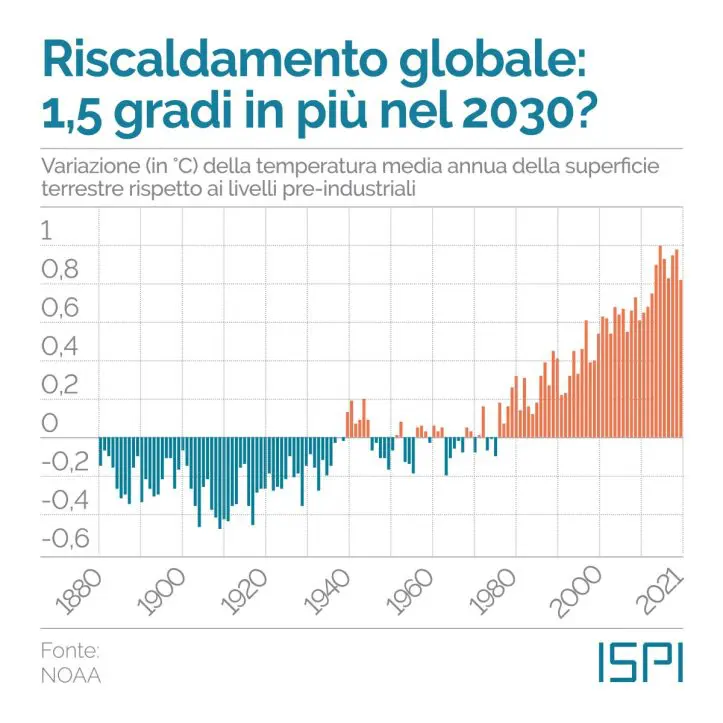
Figure 1 – Variation (°C) in the annual average surface temperature relative to pre-industrial levels.
Greenhouse gases
The concentration of CO₂ exceeded 420 ppm (parts per million) in 2023, a level not reached in the last 800,000 years. However, CO₂ is not the only greenhouse gas responsible for global warming. Other greenhouse gases are present in smaller quantities but can have a much stronger warming effect.
For example, methane (CH₄) accounted for 12% of the EU’s greenhouse gas emissions impact in 2021. Additionally, anthropogenic gases such as fluorinated gases used in industry can have a global warming effect thousands of times stronger than CO₂.
Greenhouse gases naturally occur in the atmosphere, but human activities significantly contribute to their accumulation.
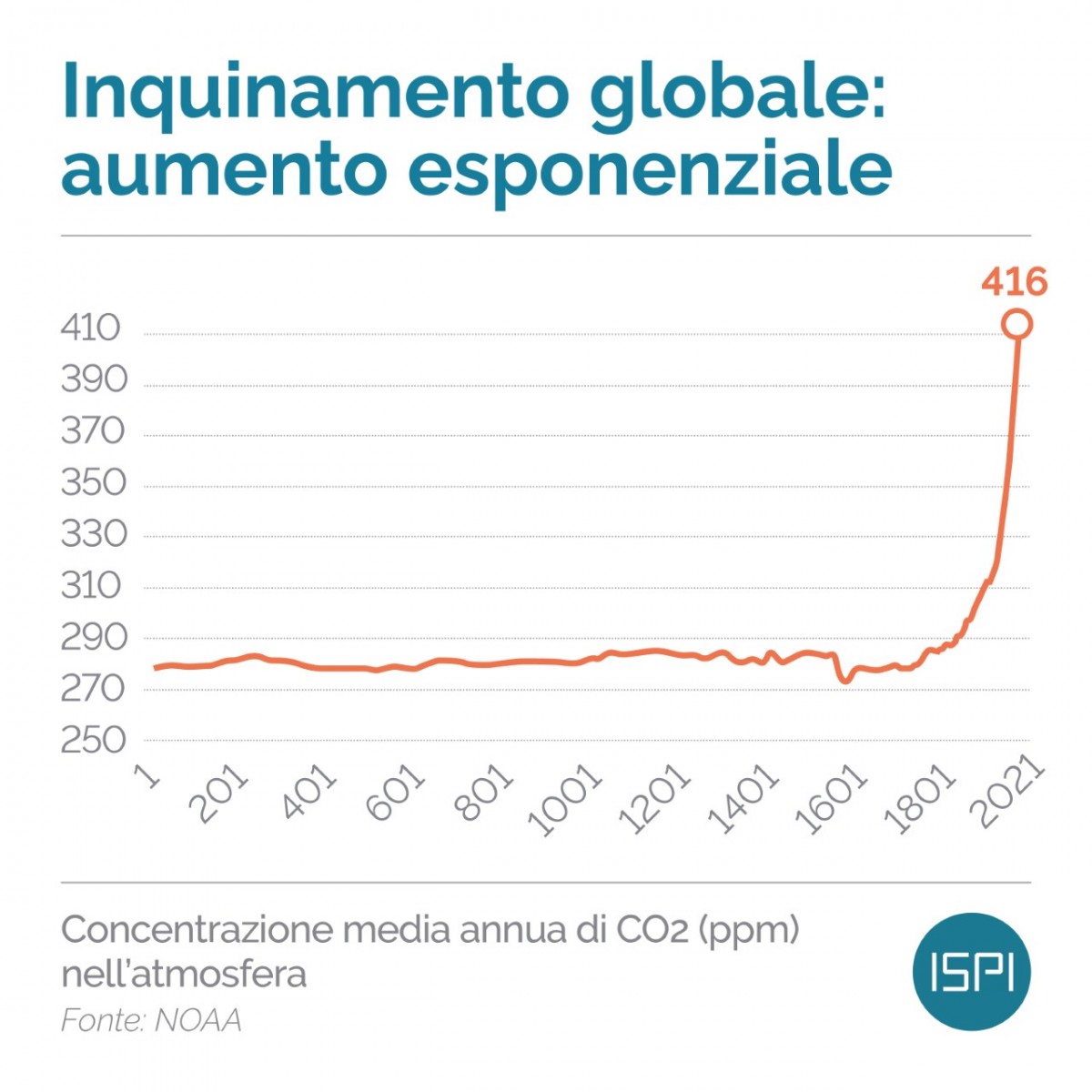
Figure 2 – Annual average CO₂ concentration (ppm) in the atmosphere.
Ice Melt
The Arctic ice is shrinking at a rate of 13% per decade. In 2023, sea ice extent reached one of the lowest levels on record.
The melting of ice in Greenland and Antarctica is contributing to rising sea levels, which have increased by approximately 20 cm since 1900.
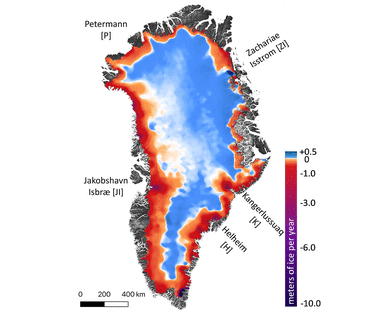
Figure 3 – Annual ice loss or gain in meters in Greenland.
The map shows the annual loss or gain of ice in Greenland in meters. The light blue areas indicate a slight increase, while the orange, red, and purple areas show the losses, ranging from the smallest to the most significant (up to 10 meters per year along the coasts).
© Smith et al. |Science
Figure 4 – Annual ice loss or gain in meters in Antarctica.
The map shows the annual ice loss or gain in Antarctica in meters. The light blue areas indicate a slight increase, while the orange, red, and purple areas show the severity of the losses, ranging from minor to more substantial (up to 10 meters per year along the coasts).
© Smith et al. |Science
1.3.3 Extreme events
Extreme weather events are atmospheric phenomena that occur with exceptional or unexpected intensity compared to the norm of a given geographical area. They are generally associated with particularly severe meteorological conditions and can have significant consequences on the territory, public health, economic activities, the environment, and society as a whole. Heatwaves, hurricanes, and torrential rainfall have become more frequent and intense worldwide.
As highlighted by Il Bo Live of the University of Padua (the official online magazine of the University of Padua), 2023 was a symbolic year for the increasing intensity and frequency of extreme climate events, emphasizing the increasingly tangible impacts of climate change on a global scale. Some of the most significant events
include:
Record global temperatures: the first days of July 2023 recorded the highest average global temperatures ever documented, exceeding 17°C for the first time, with a peak of 17.23°C on July 6. The entire month of July 2023 was recognized as the hottest ever, with a global average temperature 1.54°C higher than the pre-industrial era.
• Warming of the Mediterranean: during the summer, the surface waters of the Mediterranean Sea reached temperatures of up to 30°C, exceeding the July average by more than 5°C, with severe repercussions on marine ecosystems.
• Climate anomalies in South America: despite being winter in the Southern Hemisphere, South America experienced an unprecedented heatwave, highlighting the irregularity of current climate patterns.
• Extreme events in Italy: in 2023, Italy witnessed a series of anomalous meteorological phenomena, including significant cloudbursts in Lombardy, devastating floods such as the one in Emilia-Romagna, and repeated heatwaves affecting mainly central and southern regions between July and August.
These events, once considered exceptional, are becoming the “new normal” due to climate change. According to the latest IPCC synthesis report, a person born in 2020 will be much more likely to experience extreme events compared to their grandparents, born in the 1950s and 1960s.
Furthermore, it is emphasized that climate change does not cause the emergence of new meteorological phenomena but significantly increases their frequency and intensity. This means that events such as heatwaves and floods, although they have always existed, now occur more frequently and with greater severity.
PRACTICAL EXERCISES
PRACTICAL EXERCISE N. 1 – Climate definitions
Provide two examples for each of the following definitions. One example is in your country and the other is in one of the country descripted in the Learning Unit 2.
| Macroclimate | |
| Mesoclimate (also called topoclimate) | |
| Microclimate |
PRACTICAL EXERCISE N. 2 - Climate change and extreme weather events
Read the following scenarios and explain how they relate to climate change:
- A heatwave in South America occurs during the winter season.
- Torrential rains cause severe floods in Italy.
- The Mediterranean Sea records surface temperatures 5°C higher than usual.
How do these events impact human societies, ecosystems, and economies?
PRACTICAL EXERCISE N. 3 - Personal reflection and action plan
What can individuals do to combat climate change? List at least three actions that you can take in your daily life to reduce your carbon footprint.
Self-evaluation test
Resources/Bibliography:
https://www.focus.it/ambiente/natura/scioglimento-dei-ghiacci-le-perdite-degli-ultimi-16-anni
https://www.benjerry.it/whats-new/2020/11/extreme-weather-events
https://ilbolive.unipd.it/it/news/scienza-ricerca/dati-riscaldamento-globale-italia-2024-altro-anno
www.unric.org
Extra resources for in-deep level:
Poni S., Progettare e gestire il vigneto sostenibile in un’era di cambiamento climatico.
Dottori C., Come vignaioli alla fine dell’estate. L’ecologia vista da una vigna.
https://www.europarl.europa.eu/topics/it/article/20180703STO07123/statistiche-sul-cambiamento-climatico-in-europa
https://www.ipcc.ch/
https://www.ispionline.it/it/pubblicazione/fact-checking-i-cambiamenti-climatici-10-grafici-32170